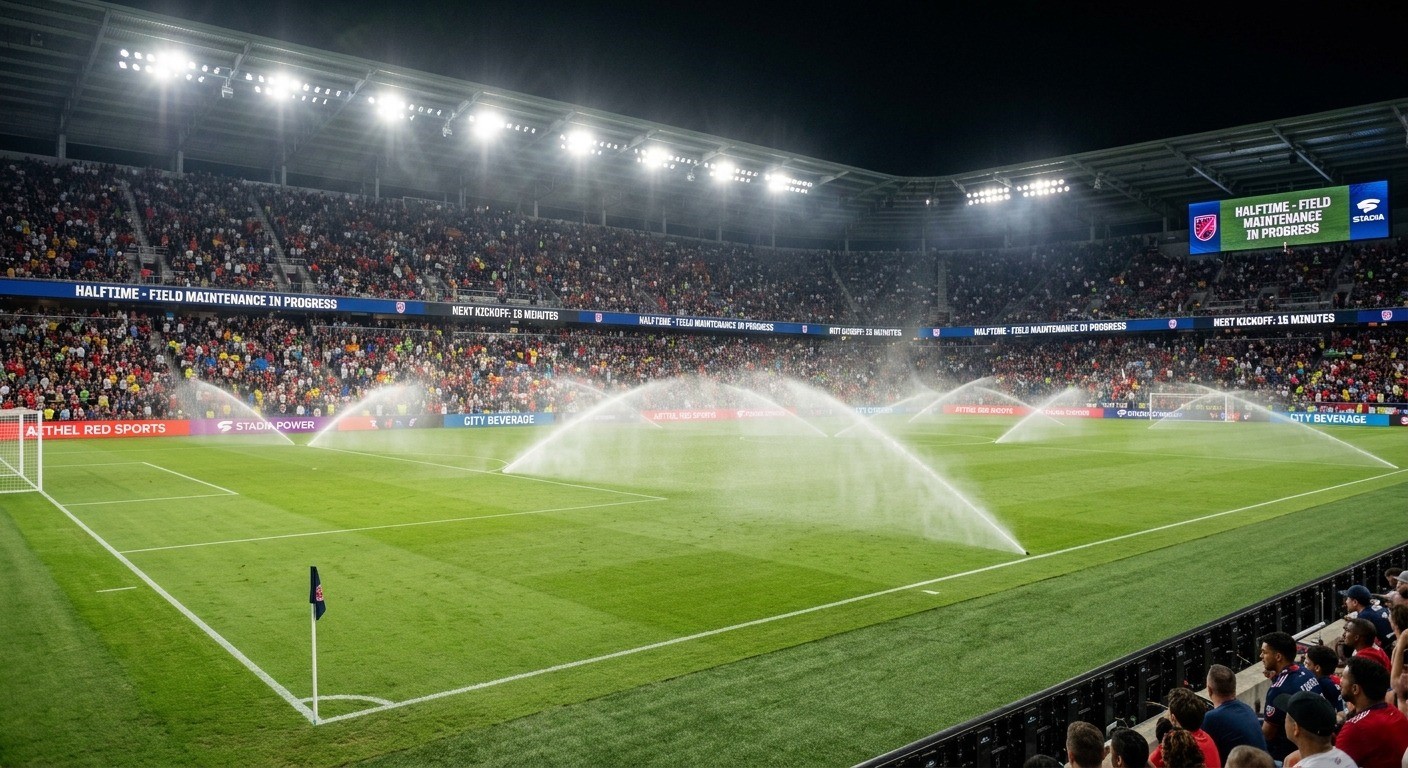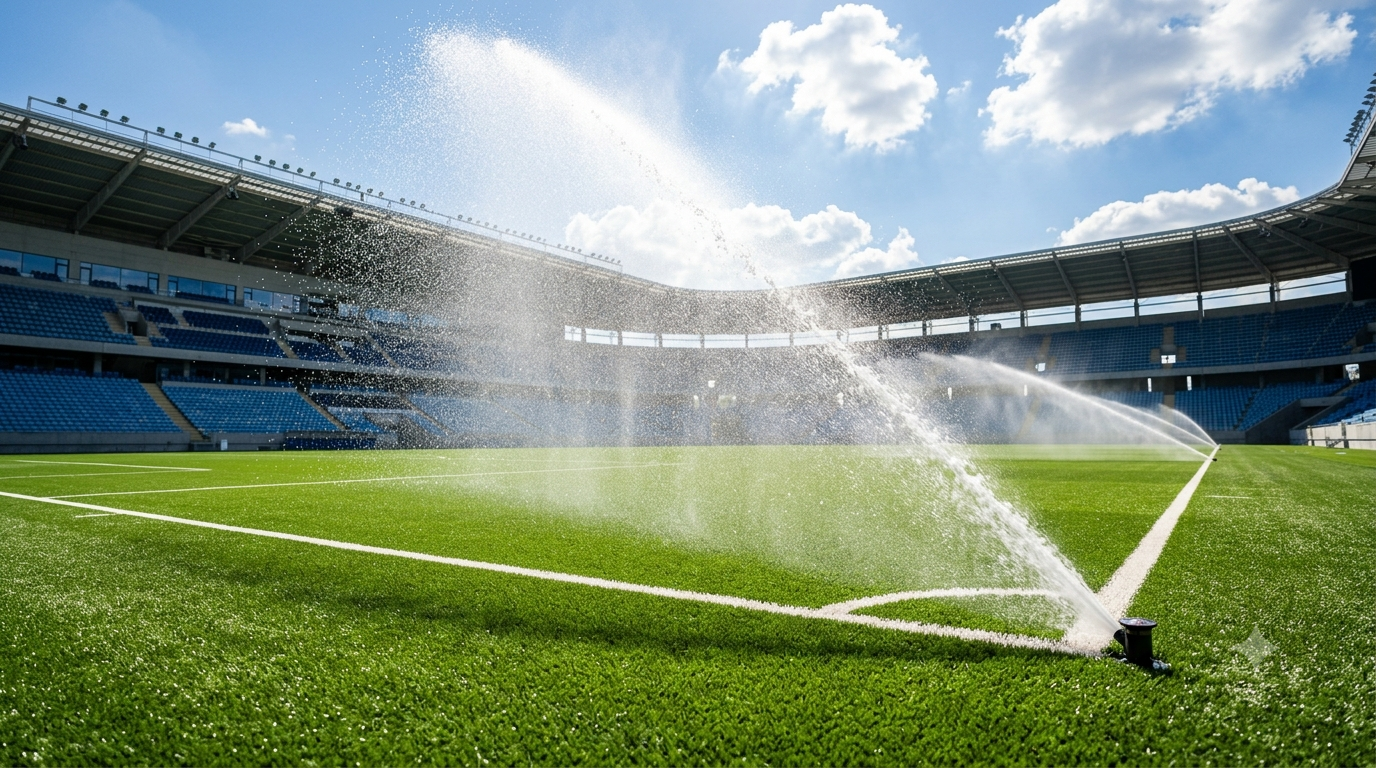


How Much Water Does a Soccer Field Need Per Week?
A professional soccer field can consume more than 150,000 gallons of water in a single week during peak summer conditions. For facility managers balancing turf quality, water restrictions, and operating budgets, knowing exactly how much water a field needs is critical.
The challenge is that there is no single answer. Water requirements vary depending on grass species, climate, soil type, field usage, and irrigation technology. This guide explains how to estimate weekly water demand and develop an irrigation strategy that maximizes turf quality while minimizing water waste.
The Baseline: Weekly Water Requirements by Turf Type
A typical full-size soccer field ranges from 1.7 to 2.0 acres, depending on field dimensions and the extent of maintained turf surrounding the playing area. At a conservative application rate of one inch of water per week — roughly the minimum required for many cool-season grasses under dry conditions — irrigation demand approaches 45,000 to 55,000 gallons weekly. While this may sustain turf survival, it rarely provides the density, uniformity, and wear tolerance expected on actively used sports fields.
For active-use fields with regular maintenance goals, the realistic range sits between 1.5 and 2.5 inches per week during peak growing season, equating to roughly 72,000 to 120,000 gallons weekly. In dry, high-temperature climates such as the American Southwest, demands can spike to 3 inches or more, pushing water consumption past 145,000 gallons.
| Grass Species | Season | Weekly Need (in.) | Gallons / Field / Week | Demand |
|---|---|---|---|---|
| Kentucky Bluegrass | Summer | 2.0 – 2.5 | 95,600 – 119,500 | High |
| Perennial Ryegrass | Summer | 1.5 – 2.0 | 71,700 – 95,600 | Medium |
| Tall Fescue | Summer | 1.25 – 1.75 | 59,750 – 83,650 | Medium |
| Bermudagrass | Summer | 1.0 – 1.5 | 47,800 – 71,700 | Low–Med |
| Zoysiagrass | Summer | 0.75 – 1.25 | 35,850 – 59,750 | Low |
| Bermudagrass | Winter (dormancy) | 0.25 – 0.5 | 12,000 – 24,000 | Low |
💡 Pro Tip
These figures assume zero rainfall contribution. Always subtract measurable precipitation from your weekly irrigation target — even a half-inch of rain eliminates three or four sprinkler cycles on a typical schedule.
The Four Variables That Shift Your Field’s Water Budget
Any single number for a soccer field’s weekly water requirement is only a starting point. Four primary factors determine whether your field falls toward the low or high end of that range — and ignoring any one of them leads to a schedule that wastes water or leaves the turf short.
1. Evapotranspiration Rate (ET)
Evapotranspiration — the combined water lost through soil evaporation and plant transpiration — is the governing metric in professional turf management. Your local ET rate, reported daily by most weather networks and Cooperative Extension Services, tells you exactly how much water the turf lost yesterday. Matching your irrigation application to the ET rate prevents both over- and under-watering with a precision that fixed schedules simply can’t achieve. During a 95°F week in July in Texas, ET can top 0.35 inches per day; the same field in October might only need 0.10 inches daily.
Most advanced irrigation programs go one step further by using reference evapotranspiration (ETo) combined with a turfgrass crop coefficient (Kc). This approach provides a more accurate estimate of actual turf water use and allows irrigation managers to fine-tune schedules based on turf species, growth stage, and field conditions.
2. Soil Type and Infiltration Rate
Sandy loam soils drain quickly, which means water moves through the root zone fast and must be replenished more frequently in smaller doses. Heavy clay soils hold water longer but are prone to compaction and surface ponding if applied faster than the infiltration rate allows. A clay field may need only four cycles per week, but each must be limited to 15–20 minutes to avoid runoff. Sand-based rootzones, commonly used in professional sports fields and stadiums, drain extremely efficiently and may require more frequent irrigation during periods of high evaporative demand.
3. Climate Zone and Seasonal Demand
The soccer field irrigation schedule that works in Portland, Oregon is a different document than the one needed in Phoenix, Arizona — even for the same grass species. Köppen climate classification, combined with local humidity, wind speed, and solar radiation, shapes how aggressively moisture leaves the plant and soil surface. Humid coastal climates often reduce irrigation needs by 30–40% compared to arid inland regions at equivalent temperatures.
4. Field Use Intensity
A field hosting two youth games per weekend recovers differently than one running adult leagues six days a week. Foot traffic compacts the soil, disrupts the thatch layer, and increases water demand by reducing the turf’s ability to absorb and retain moisture efficiently. High-use fields often require supplemental spot irrigation to cover areas of concentrated wear — center circles, penalty spots, and goalmouth zones — that degrade faster than the rest of the playing surface.
Building a Practical Irrigation Schedule
A functional weekly irrigation schedule for a soccer field rests on three principles: cycle timing, application depth, and rest intervals. Getting all three right produces turf that roots deeply, recovers quickly from play, and resists both drought and disease pressure.
Cycle and Soak: The Foundation of Efficient Watering
Rather than running one long irrigation cycle to deliver two inches of water at once, divide the weekly target across multiple shorter cycles separated by soak intervals. This technique — called “cycle and soak” — allows water to infiltrate the soil between runs rather than forming puddles or running off the surface. On a typical clay-mix rootzone, 15-minute cycles with 30-minute breaks between them produce far better soil penetration than a single 45-minute run.
Timing: Why Early Morning Matters
Irrigation timed between 3 a.m. and 7 a.m. maximizes efficiency in two ways. Evaporation loss is minimal when temperatures are low and wind is calm, meaning more of the applied water actually reaches the root zone. Foliage dries quickly after sunrise, reducing the wet-leaf period that fungal pathogens need to establish. Evening irrigation is the highest-risk scheduling choice, leaving grass blades wet through the night — a primary driver of dollar spot and brown patch outbreaks on sports turf.
Sample Weekly Schedule (Cool-Season Field, 1.75 in./week target)
- Monday / Wednesday / Friday — Two cycles, 20 min each, starting 4:00 a.m. and 4:50 a.m. → ~0.58 inches per day
- Saturday — Single maintenance cycle, 15 min, starting 5:00 a.m. → light refresh before weekend matches
- Tuesday / Thursday / Sunday — Rest days (adjust based on rainfall and ET readings)
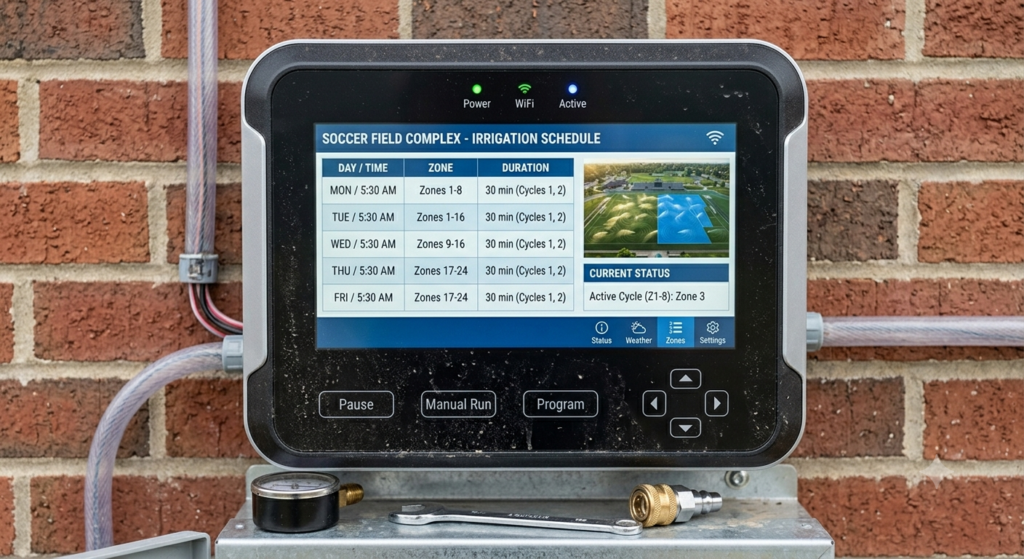 Figure 2. Smart irrigation controller mounted on a wall displaying a programmed weekly soccer field watering schedule with zone times and start times.
Irrigation Technology: Controllers, Sensors, and Smart Systems
Research has shown that weather-based smart irrigation controllers can reduce annual irrigation water use by approximately 15–40%, depending on climate, system design, and previous irrigation practices, while maintaining acceptable turf quality. For a high-demand soccer field using 100,000 gallons per week, that’s a potential saving of 1–2 million gallons per season — a meaningful figure both financially and environmentally.
Irrigation Controllers
Modern controllers like the Rain Bird ESP-TM2 or Hunter Pro-HC allow groundskeepers to program multiple start times, individual zone run lengths, and seasonal adjustment percentages from a single interface. More advanced models integrate Wi-Fi connectivity, allowing schedule modifications from any device. For a multi-zone soccer field installation — typically requiring eight to sixteen zones for complete coverage — a controller capable of managing those zones independently is essential for targeted application.
Soil Moisture Sensors
Subsurface soil moisture sensors placed at 4-inch and 8-inch depths provide real-time data on actual water content in the root zone. When connected to a compatible controller, these sensors prevent irrigation from running when soil moisture is already at field capacity — eliminating the waste that fixed schedules cause after rain events. A well-calibrated moisture sensor network is one of the highest-ROI investments available for sports field water management.
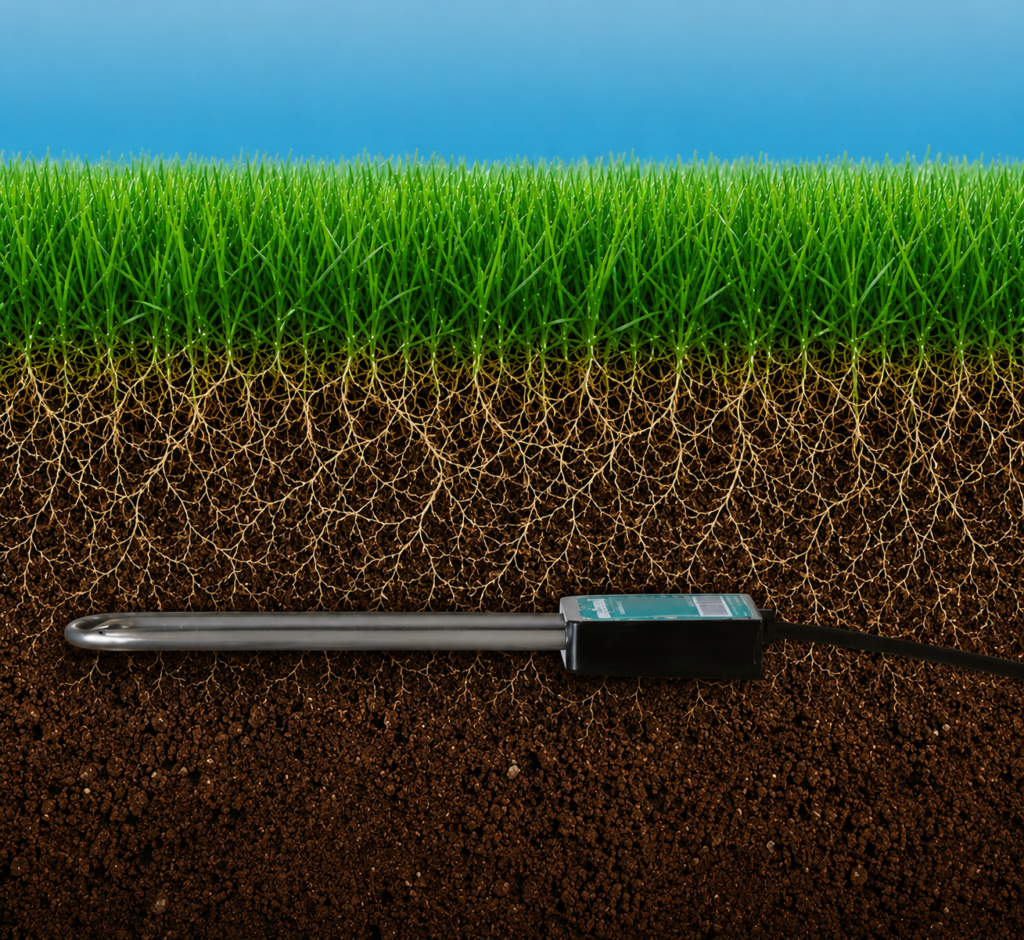
Figure 3. Soil moisture sensor installed below the grass surface.
Weather-Based ET Controllers
Numerous university studies have demonstrated that ET-based irrigation scheduling consistently outperforms fixed-time irrigation programs in both water-use efficiency and turf quality preservation.
ET controllers pull local weather data — temperature, humidity, wind speed, solar radiation — and calculate a daily ET value that automatically adjusts the irrigation schedule. Rather than running a fixed number of minutes on a preset schedule, the controller runs only what the turf actually needs. These systems are now standard equipment at MLS-level and university athletic facilities, where turf quality is non-negotiable and water costs are actively managed.
Example Calculation
If local ETo is 0.25 inches/day and the turfgrass Kc is 0.8, daily turf water use equals:
ETc = ETo × Kc
ETc = 0.25 × 0.8 = 0.20 inches/day
Nozzle Selection and Pressure Management
Even the best irrigation schedule cannot compensate for poor sprinkler performance. Incorrect nozzle selection, worn nozzles, or excessive operating pressure often lead to misting, wind drift, and uneven water distribution. Routine pressure testing and nozzle inspections help improve distribution uniformity, increase irrigation efficiency, and reduce unnecessary water consumption. In many facilities, correcting pressure-related issues produces immediate water savings without requiring any changes to the irrigation schedule.
Water Conservation Without Sacrificing Turf Quality
Responsible water use on sports turf is no longer optional in many regions — drought mandates, tiered utility pricing, and facility sustainability commitments have made conservation an operational requirement. The good news is that the most effective conservation techniques also produce better turf, not worse.
Deep, Infrequent Watering
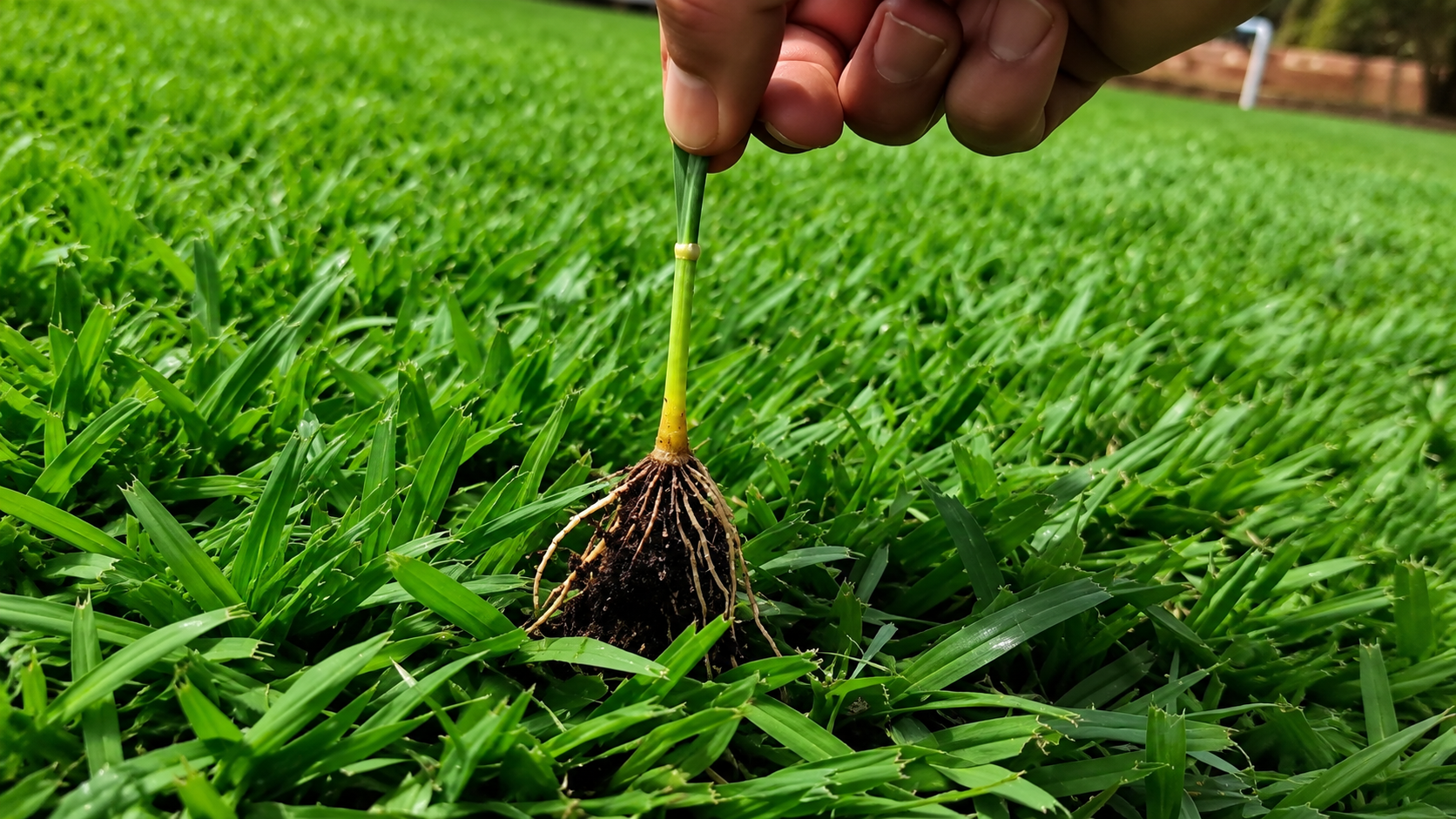
Training roots to reach deeper into the soil profile — through irrigation cycles that wet the root zone to a depth of 6 to 8 inches — produces turf that is inherently more drought-resilient. Deep roots access water stored lower in the profile during dry spells, reducing the frequency of irrigation needed to maintain acceptable surface conditions. The common mistake of daily light watering keeps roots shallow and makes the turf permanently dependent on constant moisture at the surface.
Deficit Irrigation During Dormancy or Off-Season
During field rest periods or late-season cool-down, reducing irrigation to 60–70% of ET replacement — a technique called deficit irrigation — maintains turf viability without sustaining active growth. This approach is particularly effective for warm-season grasses like Bermudagrass and Zoysiagrass transitioning toward dormancy, where the objective shifts from growth support to survival maintenance.
Auditing Your System for Uniformity
An irrigation system with poor distribution uniformity (DU) wastes water by overwatering some zones to ensure adequate coverage in underserved areas. A DU below 70% — measurable with a simple catch-can test using shallow containers placed across the field — signals that head spacing, nozzle selection, or system pressure needs correction before any scheduling optimization will be effective.
📌 Key Takeaway
Water-efficient soccer field irrigation is not about reducing what you apply — it’s about eliminating the water that never reached the intended target. Fix distribution before cutting volume.
Frequently Asked Questions
How many gallons of water does a soccer field use per week?
A standard full-size soccer field (1.7 -2.0 acres) typically uses between 47,800 and 120,000 gallons per week during active growing season, depending on grass species, climate, and irrigation efficiency. In hot, arid climates, weekly consumption can exceed 145,000 gallons. Rainfall offsets this figure directly, so weekly needs vary significantly with local weather.
How often should you water a soccer field?
Most soccer fields benefit from irrigation three to five times per week during summer, using a cycle-and-soak approach rather than single long runs. High-use or sand-based fields may need daily irrigation during heat stress periods. Off-season and cool-season maintenance typically requires one to two sessions per week, adjusted for rainfall.
What time of day is best to irrigate a soccer field?
Early morning — between 3 a.m. and 7 a.m. — is the optimal window for soccer field irrigation. Evaporation rates are lowest in the pre-dawn hours, maximizing the efficiency of every gallon applied. Foliage dries naturally after sunrise, reducing disease pressure from fungal pathogens that thrive on wet turf overnight.
Does grass type affect how much water a soccer field needs?
Yes — significantly. Cool-season grasses like Kentucky Bluegrass demand 2.0 to 2.5 inches per week in summer and consume up to 30% more water than warm-season alternatives. Bermudagrass and Zoysiagrass are considerably more drought-tolerant, requiring as little as 0.75 to 1.5 inches weekly under comparable conditions. Selecting the right species for your climate is one of the highest-impact conservation decisions available.
How do smart irrigation controllers save water on sports fields?
Smart ET-based controllers automatically adjust irrigation schedules using real-time weather data, replacing fixed timers that run regardless of actual turf need. By matching application to measured evapotranspiration rates, these systems typically reduce annual water consumption by 15–40% without any reduction in turf quality — representing hundreds of thousands of gallons saved per field each season.
Build the Right Irrigation System for Your Field
The most successful sports turf managers don’t guess how much water their fields need — they measure, monitor, and adjust. Whether you’re upgrading an existing irrigation system or planning a new installation, selecting the right controller, sensors, and scheduling strategy can significantly improve turf quality while reducing water costs.