

If you’ve ever wondered how professional stadiums consistently produce crisp, uniform turf striping patterns, the answer lies in a combination of specialized equipment, turfgrass characteristics, and precise mowing techniques.
The perfectly defined stripes seen on World Cup fields, Premier League stadiums, NFL venues, and elite sports facilities are not painted onto the grass. Instead, they are created through a process known as turf striping, one of the most recognizable indicators of professional sports field maintenance.
Here’s how it works.
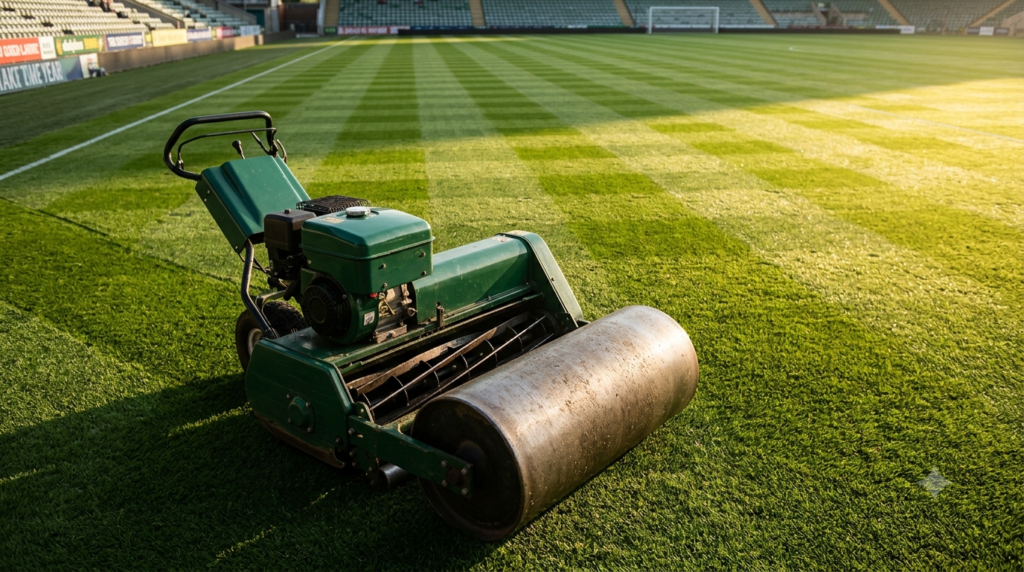
Figure: Reel mower with rear roller on a professional sports field
How Soccer Field Stripes Are Actually Made
Professional turf stripes are created by light reflection, not by differences in grass color.
Sports field managers use reel mowers equipped with rear rollers. As the mower cuts the turf, the roller gently bends the grass blades in a specific direction.
When adjacent mowing passes are made in opposite directions, the grass reflects sunlight differently:
- Grass blades bent away from the viewer appear lighter.
- Grass blades bent toward the viewer appear darker.
Although the entire field is maintained at the same mowing height, the different orientations of the leaf blades create the alternating light and dark bands associated with professional turf striping.
The effect becomes most pronounced under bright sunlight, when direct light increases contrast between adjacent mowing passes.
The visibility of sports field striping is also influenced by roller design, roller weight, turf density, mowing height, and grass species.
Why Professional Stadiums Use Turf Striping
Turf striping serves purposes beyond aesthetics.
Professional sports facilities use turf striping patterns to:
- Enhance overall field appearance.
- Improve television and broadcast presentation.
- Demonstrate maintenance quality and professionalism.
- Help operators maintain straight mowing lines.
- Reinforce the visual identity of the venue.
- Create a premium experience for athletes, spectators, and broadcasters.
For many high-profile facilities, the condition and appearance of the field are viewed as an extension of the organization’s brand.
Viewing Angle Changes the Appearance
One of the fascinating aspects of turf striping is that the pattern changes depending on the viewing angle.
From the primary television camera position, stripes often appear to run across the field.
From behind the goal, the same stripes may appear lengthwise.
From certain stadium locations, intersecting mowing directions can create a subtle checkerboard effect.
To maintain a consistent appearance from multiple viewing angles, many sports turf managers periodically incorporate different mowing directions into their maintenance programs.
Best Grass Types for Creating Strong Turf Stripes
Not all turfgrass species produce the same striping effect.
Fine-textured grasses with upright growth habits generally create the strongest visual contrast.
Warm-Season Turfgrasses
The most common warm-season species used for striping include:
- Bermudagrass
- Zoysiagrass
Bermudagrass is particularly well known for producing sharp, highly visible stripes when maintained with reel mowers and rear rollers.
Cool-Season Turfgrasses
Several cool-season species also produce excellent striping patterns, including:
- Kentucky Bluegrass
- Perennial Ryegrass
Dense, healthy turf with a uniform canopy will generally produce more consistent and visually appealing striping patterns regardless of species.
For stadiums and high-visibility sports venues, selecting a turfgrass variety with strong striping potential can significantly enhance field presentation.
5 Tips for Creating Professional-Quality Turf Stripes
1. Use a Reel Mower with a Rear Roller
Reel mowers remain the industry standard for professional sports field striping.
While rotary mowers can create some striping—especially when equipped with striping kits—reel mowers generally produce the sharpest and most consistent patterns.
Professional equipment from manufacturers such as Toro, Jacobsen, and John Deere is commonly used on elite sports fields.
2. Keep Blades Sharp and Mowing Height Consistent
Sharp reel blades produce clean cuts, reduce turf injury, and improve overall playing surface quality.
Professional soccer fields are often maintained between 1 and 1.5 inches (25 to 40 mm), a range that typically provides excellent striping visibility while maintaining playability.
3. Mow in Straight, Parallel Passes
Consistency is critical.
Most operators use field markings as guides for the initial pass and maintain parallel lines throughout the mowing operation.
Even minor deviations can become highly visible across the length of a soccer field.
4. Rotate Mowing Directions
Repeated mowing in the same direction can encourage grain development and cause turf to lean over time.
Alternating striping patterns helps maintain upright growth, improves turf quality, and preserves visual contrast.
5. Focus on Operator Precision
Even the best equipment cannot compensate for poor execution.
Professional-quality striping requires an experienced operator with attention to detail, consistent mowing speed, and precise alignment throughout the operation.
Does Turf Striping Affect Turf Health?
Turf striping itself does not harm turfgrass when mowing is performed correctly.
However, repeatedly mowing in the same direction can contribute to grain development, uneven growth patterns, and reduced stand uniformity.
Rotating mowing directions is considered a best management practice because it promotes more upright growth and improves overall turf quality.
For this reason, many professional sports field managers vary their striping patterns throughout the season.
Common Mistakes to Avoid
Mowing Extremely Dry Turf
Moderately hydrated turf generally produces stronger striping effects than excessively dry turf because the leaf blades bend more uniformly beneath the roller.
Skipping the Perimeter Pass
A clean perimeter pass creates a finished appearance and visually frames the striping pattern.
Even excellent stripes can appear incomplete without a properly defined border.
Mowing Too Infrequently
As turf grows, striping contrast gradually fades.
Many high-profile sports fields are mowed every two to three days—and sometimes daily during tournaments or televised events—to maintain maximum visual impact.
Conclusion
The iconic stripes seen on World Cup and professional soccer fields are the result of far more than simple mowing. They are created through a combination of specialized reel mowing equipment, appropriate turfgrass selection, proper mowing practices, favorable lighting conditions, and skilled operation.
When these factors come together, the field becomes more than just a playing surface—it becomes part of the event itself.
For sports turf managers, mastering professional turf striping is one of the simplest ways to elevate both field presentation and perceived facility quality.
Looking for More Sports Turf Management Insights?
Explore our growing library of practical resources at TurfWaterPro, where we cover irrigation scheduling, water management, system maintenance, sports field performance, and best management practices for athletic turf.
Related Reading:
Sod Grown on Plastic (SOP): Stadium Turf Tech Explained
https://www.turfwaterpro.com/sod-grown-on-plastic-stadium-turf-technology/