


A soccer field can look perfect from the stands and still perform poorly when a player plants a foot to change direction. That gap between appearance and actual performance is what separates an ordinary field from a high-performance soccer field.
High performance is not simply about having expensive grass or a large construction budget. It is the result of several systems working together: surface characteristics, rootzone construction, drainage, irrigation uniformity, and turfgrass selection and management.
This guide explains what makes a soccer field perform at a high level, which characteristics can be measured, and which decisions have the greatest influence on consistency, durability, and playability.
What Defines a High-Performance Soccer Field?
A high-performance soccer field should provide consistent playing conditions across the entire surface.
FIFA’s Quality Programme for Natural Playing Surfaces provides a standardized testing procedure and reporting format that allows clubs and competition organizers to evaluate natural playing surfaces using consistent criteria. The program considers characteristics related to player-surface interaction and ball behavior, helping professionals assess the quality of a field beyond its visual appearance.
Important performance characteristics include:
- Surface hardness and impact response
- Rotational resistance and traction
- Ball roll
- Ball rebound
- Surface evenness
- Turfgrass density and condition
- Consistency across different areas of the field
The important point is simple: a high-performance soccer field is defined by measurable and repeatable playing characteristics, not simply by how green it looks.
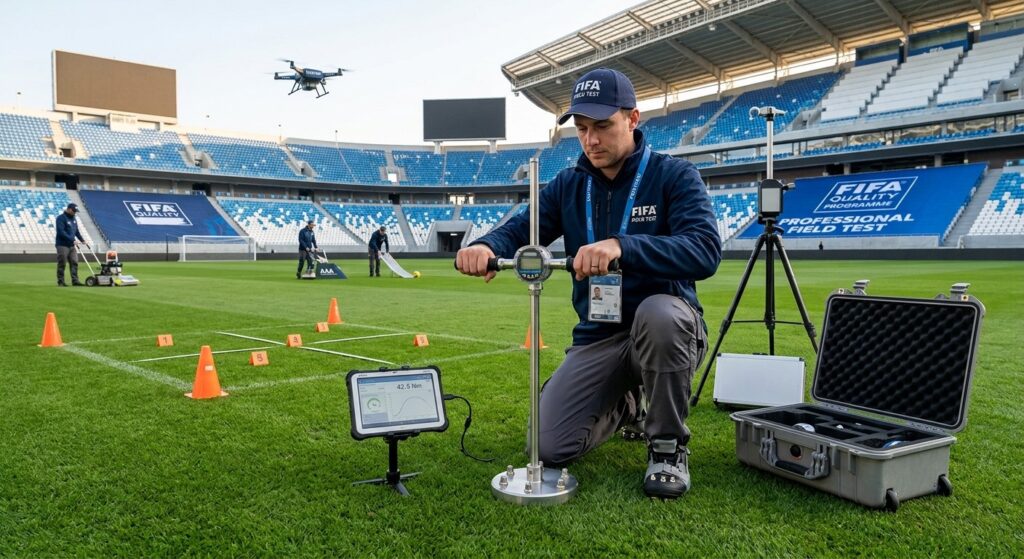
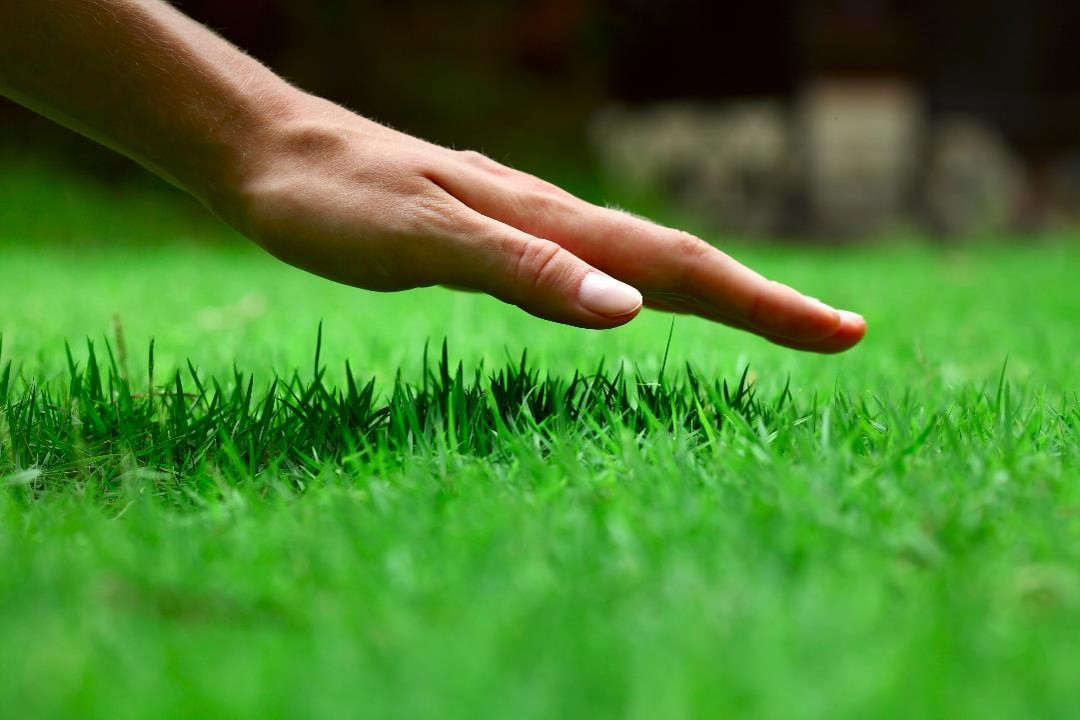
Figure 1: Measurement of rotational traction on soccer field surface (AI Image).
The Five Pillars of a High-Performance Soccer Field
A reliable professional field can be understood through five interconnected pillars:
| Pillar | What It Controls |
| Surface performance | Traction, firmness, ball response, and player interaction |
| Rootzone | Water availability, aeration, rooting, and structural stability |
| Drainage | Removal of excess water and field availability after rainfall |
| Irrigation | Uniform soil moisture and replacement of water lost through evapotranspiration |
| Turfgrass | Density, recovery, wear tolerance, and adaptation to climate and light |
These components should not be designed independently. A high-quality rootzone cannot compensate for poor irrigation uniformity, and an excellent irrigation system cannot solve a fundamentally inadequate drainage system.
ASTM F2396 specifically notes that decisions regarding sand-based rootzones on high-performance fields should consider existing soil, climate, level of play, frequency and intensity of use, available equipment, budget, training, and management capability.
The Foundation: What Happens Below the Grass Matters
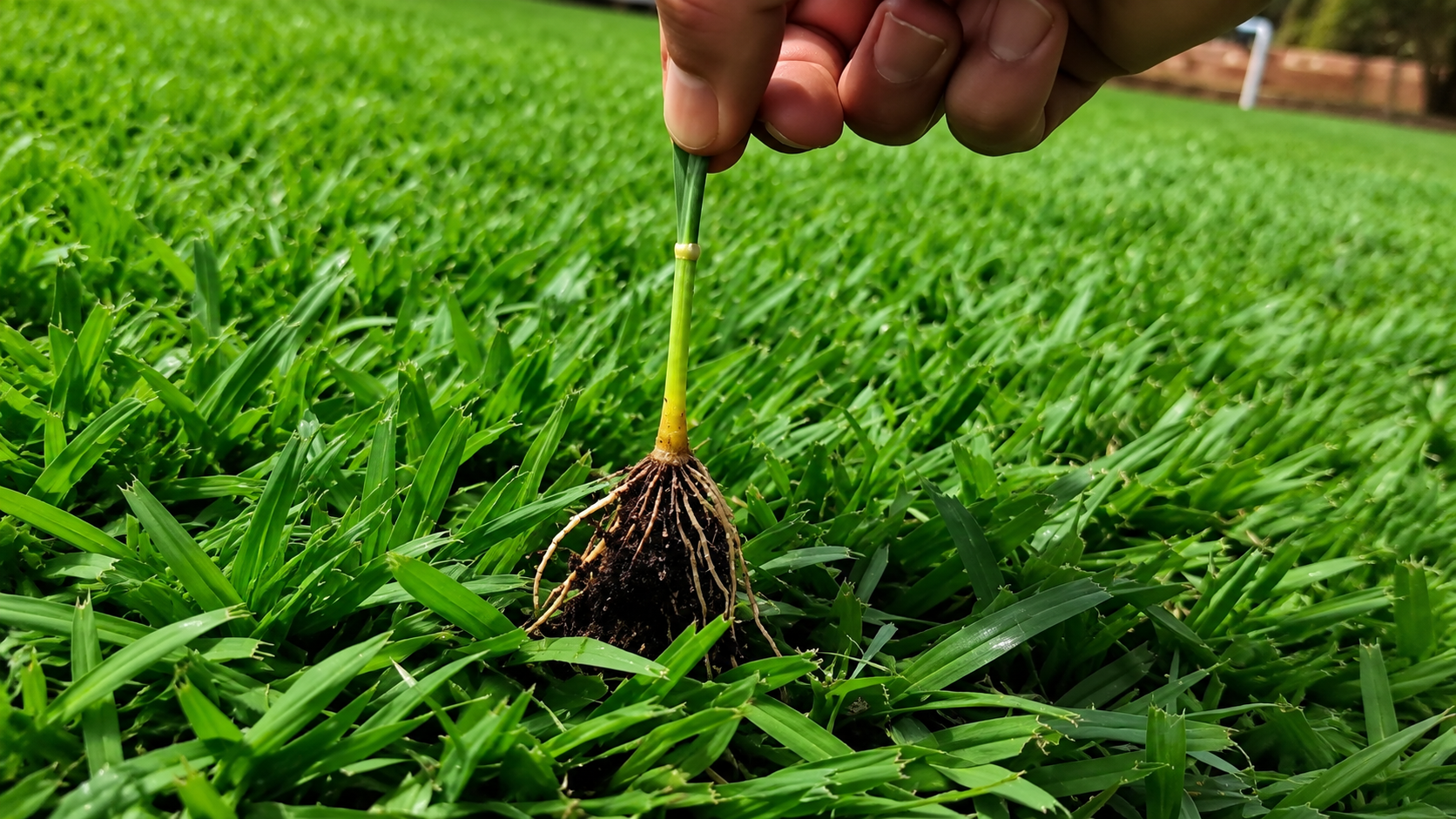
The rootzone is one of the most important components of a high-performance soccer field.
Sand-based construction is widely used for high-traffic athletic fields because properly selected sand can provide good drainage, aeration, and resistance to compaction compared with native soils with finer particles under wet conditions. ASTM describes sand as a common construction material for high-performance sports-turf rootzones for precisely these reasons.
However, sand alone does not create a high-performance field.
Performance depends on the complete profile: sand particle-size distribution, organic matter, gravel or drainage layers, subsurface drainage, grading, irrigation, and maintenance.
Oregon State University’s PNW 675 guidance, for example, describes a traditional sand-based athletic-field profile with approximately 16 inches of total construction depth, including about 12 inches of sand and 4 inches of fine gravel. The publication also emphasizes that drainage, sand selection, grading, and turfgrass selection must work together.
This should be viewed as one established construction approach—not a universal depth requirement for every soccer field.
Sand Particle Size Matters
One of the most common mistakes is selecting rootzone sand based on a commercial name rather than laboratory analysis.
Two materials marketed as “sports turf sand” or “USGA sand” can have significantly different particle-size distributions and therefore different hydraulic behavior.
PNW 675 provides particle-size guidance for sand-based athletic-field construction, while ASTM maintains specific test methods for particle-size analysis and other physical properties of athletic-field rootzone materials.
Professional recommendation: specify the physical properties of the rootzone material and require laboratory testing before installation rather than selecting sand based solely on supplier terminology.
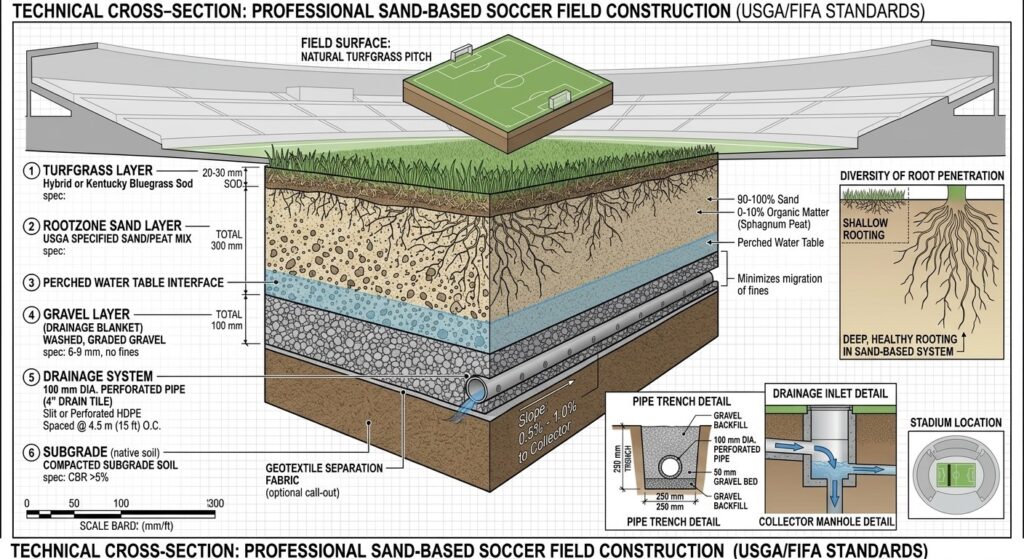
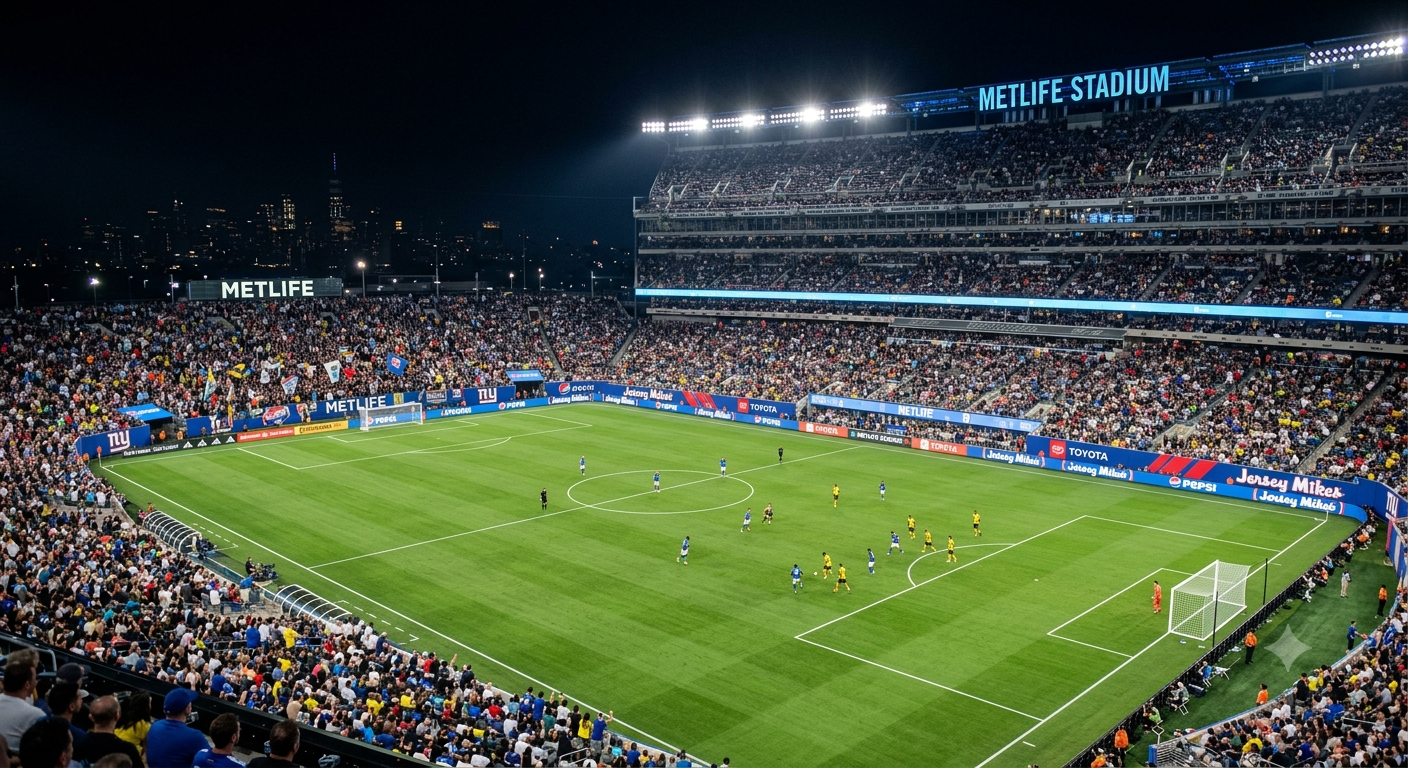
Figure 2: High-Performance Soccer Field Rootzone Design.
Drainage: Keeping the Field Playable After Rain
A professional soccer field must do more than drain water eventually. It must maintain acceptable playing conditions during and after significant rainfall.
Subsurface drainage removes excess water from the rootzone and helps prevent prolonged saturation. However, drainage performance depends on more than the number of drain pipes installed.
The relationship between surface grading, rootzone hydraulic properties, drainage materials, pipe spacing, outlet capacity, and subsurface conditions determines how effectively water leaves the field.
Oregon State guidance emphasizes that high-quality sand-based athletic fields depend on coordinated construction components, including sand selection, base grade, surface drainage, subsurface drainage, and turfgrass selection.
A drainage system should therefore be designed as part of the rootzone—not added as an isolated component after the field design is complete.
Irrigation Uniformity: The Variable Many Fields Get Wrong
A well-designed rootzone can still produce poor turf if irrigation water is distributed unevenly.
Distribution Uniformity (DU) measures how evenly an irrigation system applies water across a defined area. Low uniformity creates areas that receive substantially different amounts of water during the same irrigation cycle.
For Lower Quarter Distribution Uniformity:
DUₗq = (Low-quarter average ÷ Overall average) × 100
A Practical Example
Imagine a catch-can test produces:
- Overall average application = 20 mm
- Average of the lowest 25% of catch cans = 12 mm
Therefore:
DUₗq = (12 ÷ 20) × 100 = 60%
A DU of 60% means the lowest-quarter area receives, on average, only 60% of the overall application depth.
The manager then faces a difficult choice: increase runtime to provide enough water to the driest areas, while simultaneously applying more water to areas that are already receiving adequate amounts.
The Irrigation Association’s audit guidance uses the low-quarter approach and provides procedures for collecting catch-can data and calculating DU. Its recommended audit framework also incorporates pressure, spacing, precipitation rate, soil type, rootzone depth, wind conditions, and other field variables.
For rotor irrigation systems, a DUₗq of 0.70 or higher is a useful professional performance target; higher uniformity provides greater flexibility when establishing irrigation schedules. The Irrigation Association’s materials identify 70% as a minimum benchmark for rotor-head systems in its turf and landscape irrigation best-management context.
The key lesson: before increasing irrigation runtime to solve dry spots, determine whether the real problem is inadequate water supply—or poor distribution.
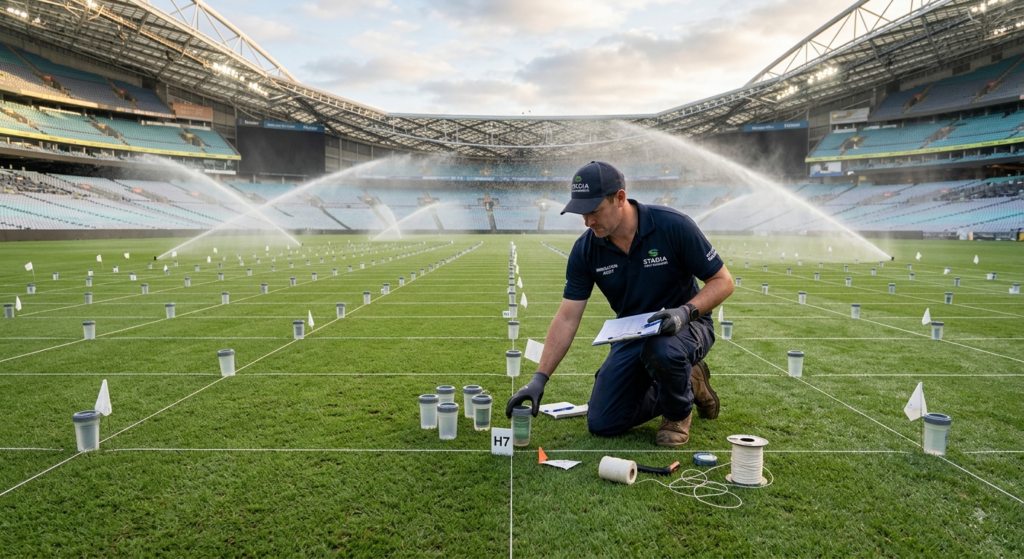
Figure 3: Distribution Uniformity Test on a Soccer Field.
Evapotranspiration and Irrigation Scheduling
Once the irrigation system distributes water uniformly, the next question is how much water the turf actually needs.
Professional irrigation programs should not rely exclusively on fixed calendar schedules.
Reference evapotranspiration (ETo) provides an estimate of atmospheric water demand. Turfgrass water requirements can then be estimated by considering the crop coefficient (Kc) and other site-specific factors.
A simplified relationship is:
ETc = ETo × Kc
This provides a starting point for irrigation scheduling. Field managers should then consider rainfall, effective precipitation, soil moisture, rootzone characteristics, irrigation efficiency, and actual turfgrass condition.
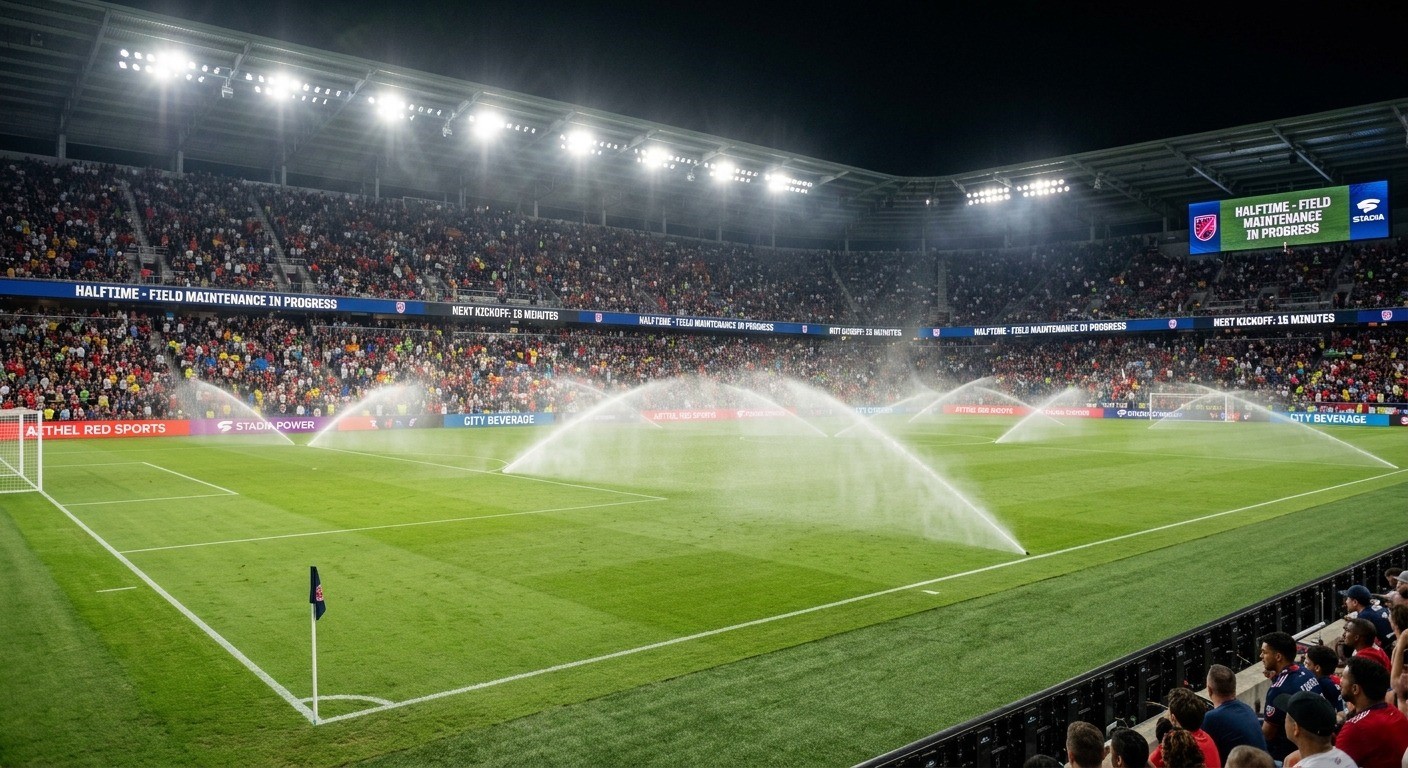
A weather-station-based controller can automate portions of this process, while soil-moisture sensors provide direct information about conditions within the rootzone.
The two approaches complement each other: ET estimates atmospheric demand, while soil-moisture measurements help verify what is actually happening in the rootzone.
Professional recommendation: use technology to improve decision-making—not to replace field observation and system calibration.
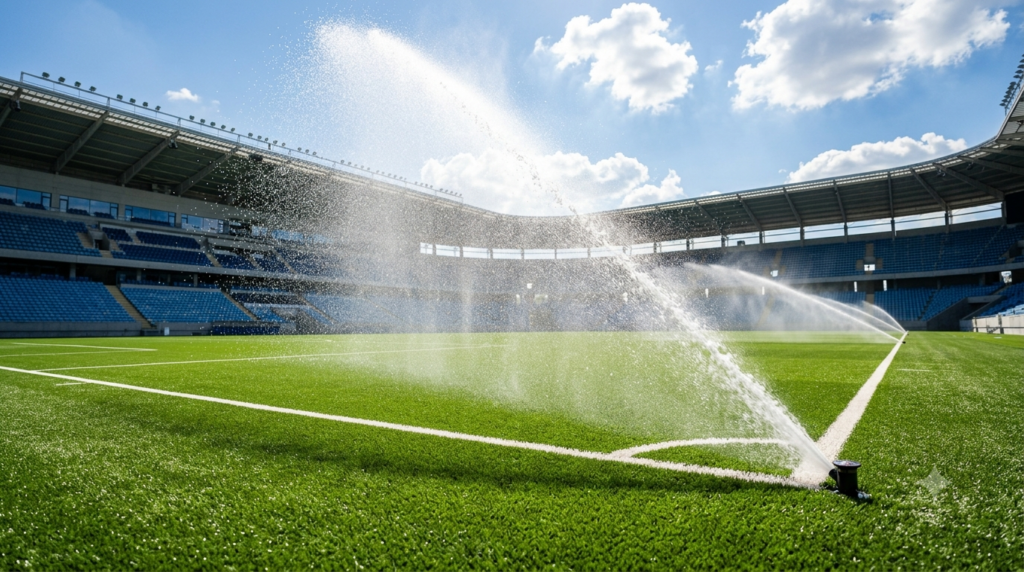
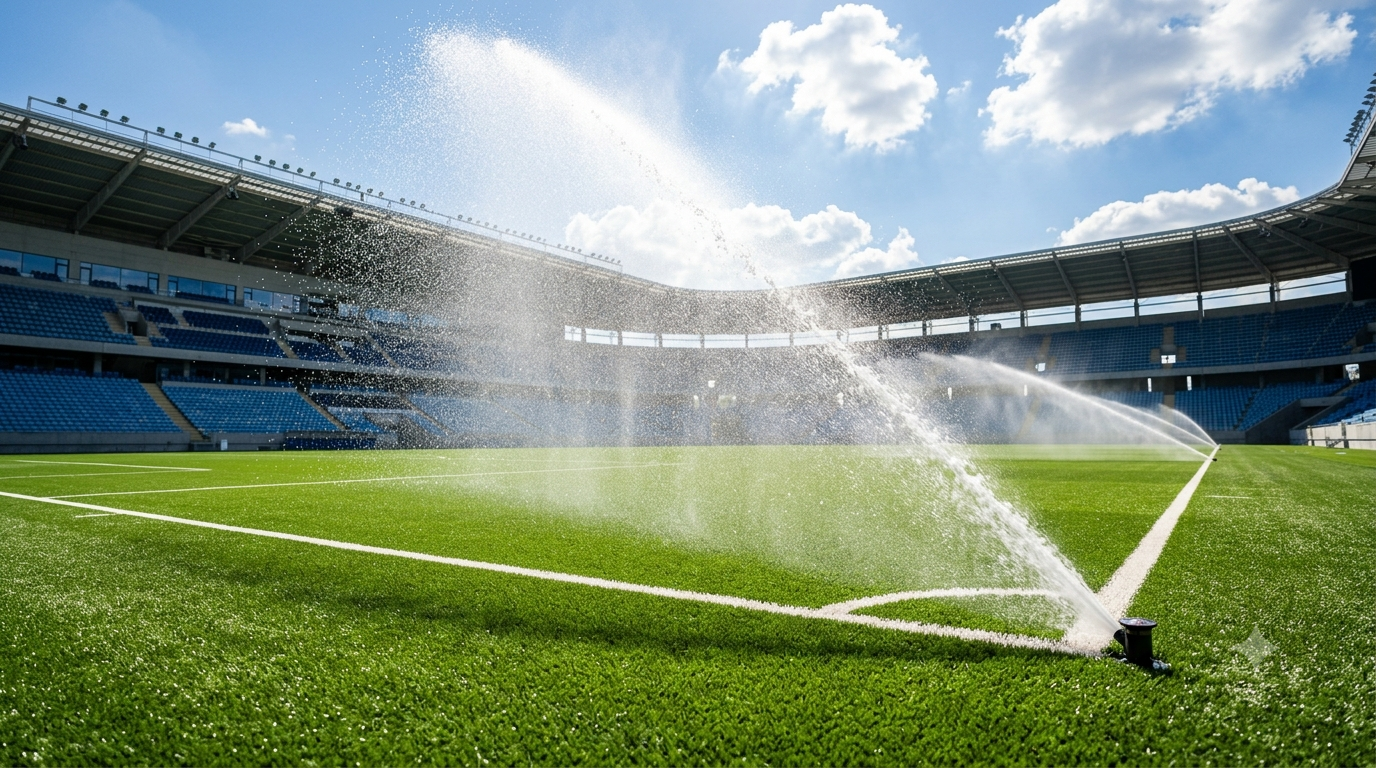
Figure 4. Professional soccer field irrigation.
Turfgrass Selection: Match the Grass to the Environment
No single turfgrass species defines a high-performance soccer field.
The correct selection depends on:
- Climate
- Soil temperature
- Available sunlight
- Stadium architecture
- Traffic intensity
- Recovery requirements
- Irrigation capacity
- Maintenance resources
Warm-season grasses such as Bermudagrass are widely used in warmer regions because of their aggressive growth, recovery capacity, and tolerance of high temperatures.
Cool-season grasses such as Kentucky bluegrass and perennial ryegrass can be advantageous in cooler climates and certain low-light environments.
The most important lesson is that microclimate can be more important than regional climate alone.
A stadium in a warm region with a roof or limited sunlight may create a growing environment very different from an open-air field only a few miles away.
FIFA’s Natural Turf Guidelines specifically emphasize selecting grass species according to climate and the practical conditions in which the field must be established and maintained.
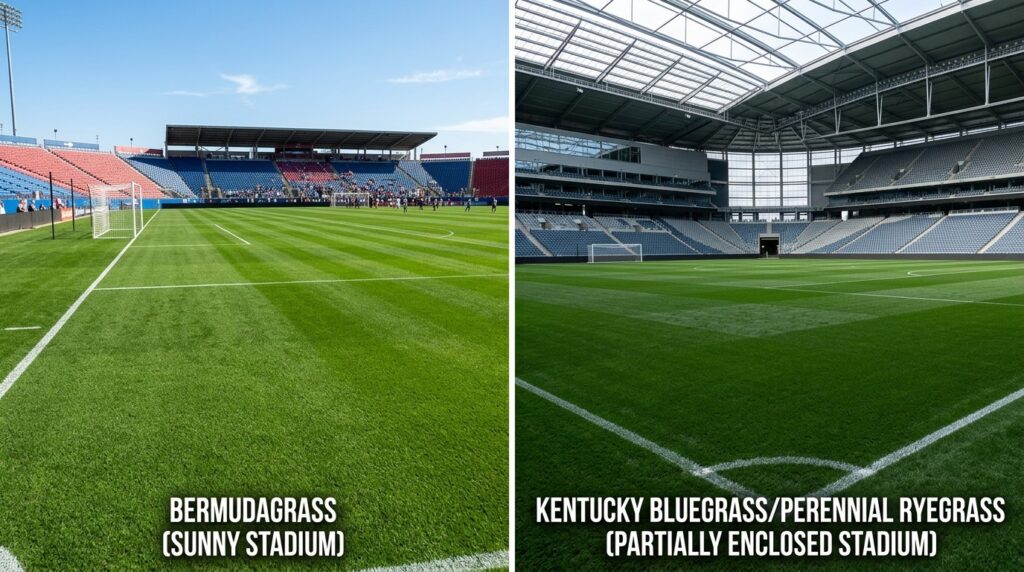
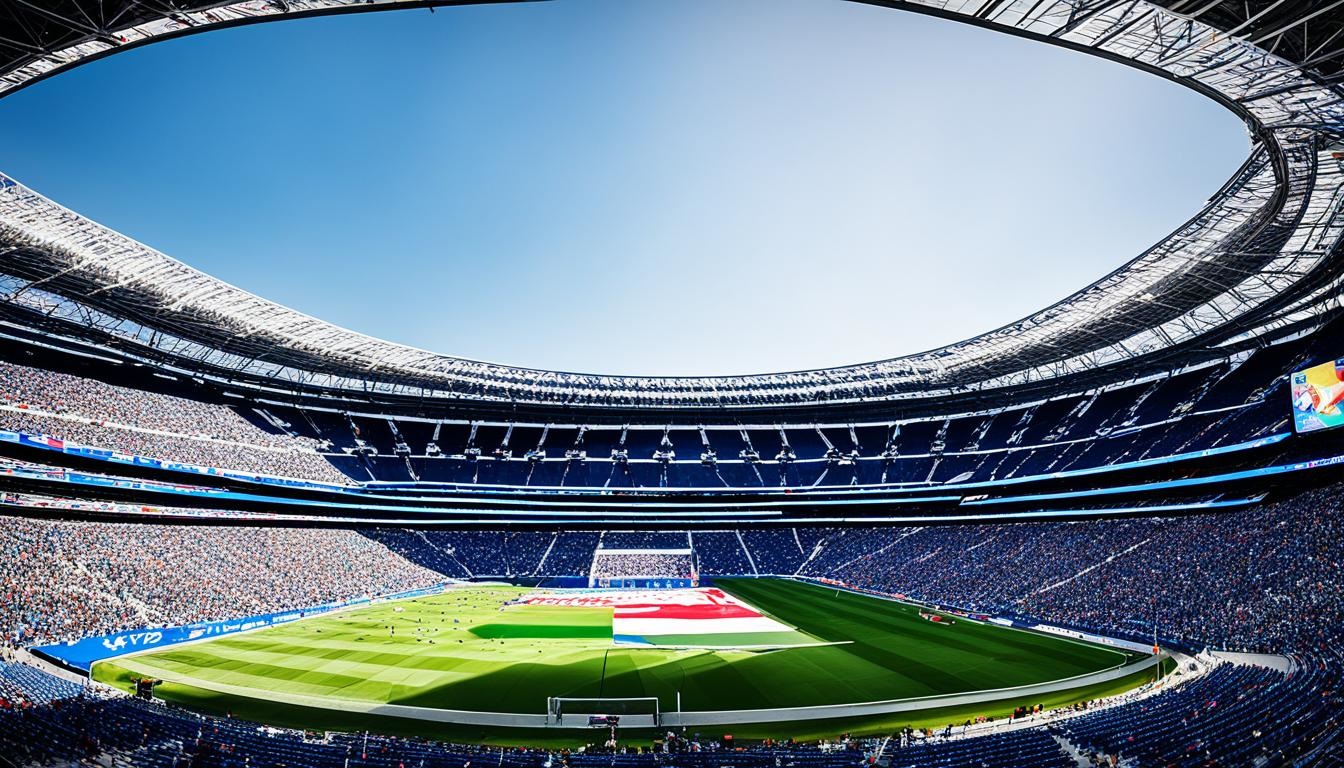
Figure 5: Choosing Turfgrass for Soccer Field Conditions.
Rootzone Approaches by Facility Type
There is no single construction system suitable for every facility.
| Facility Type | Possible Rootzone Approach | Main Advantage | Main Consideration |
| Professional stadium | Full sand-based profile | High drainage and traffic tolerance | High construction and maintenance requirements |
| University / college | Full sand-based or sand-cap system | Strong performance-to-cost balance | Requires skilled management |
| Municipal / school | Sand-cap or improved native-soil system | Lower construction cost | Performance depends heavily on existing subsoil |
| Community field | Native soil or amended profile | Lower upfront cost | Greater weather sensitivity |
These categories are general planning examples, not prescribed standards. ASTM specifically notes that rootzone decisions must account for site-specific conditions, climate, level of play, intensity of use, available resources, and management capability.
Does a High-Performance Field Need Hybrid Turf?
Not necessarily.
Hybrid reinforcement is one strategy for increasing surface stability and wear tolerance, particularly where fields face intense traffic and compressed schedules.
FIFA’s natural-playing-surface framework recognizes different categories of natural surfaces and evaluates them according to standardized testing procedures. Hybrid reinforcement can therefore be an important design option, but it should not be treated as a universal requirement for every high-performance natural-grass field.
The decision should consider expected traffic, recovery time, maintenance resources, construction system, and performance objectives.
For elite venues hosting frequent matches, hybrid reinforcement may provide an important additional margin of durability.
Common Mistakes That Undermine Field Performance
Specifying sand by name instead of laboratory testing
A product label does not guarantee the physical properties required for the project. Rootzone materials should be tested against the project’s specifications.
Treating irrigation separately from rootzone design
A rootzone with different water-holding and drainage characteristics requires a corresponding irrigation strategy.
Ignoring irrigation uniformity
Increasing runtime is not a substitute for fixing poor sprinkler spacing, pressure, nozzle selection, or head alignment.
Assuming a deeper rootzone is always better
Rootzone depth should be determined by the complete system design and site requirements rather than by a single universal number.
Choosing turfgrass based only on climate zone
Temperature is important, but stadium shade, roof structure, artificial lighting, traffic, and recovery requirements can change the optimal turfgrass choice.
Treating technology as a substitute for field observation
Smart controllers, weather stations, and soil-moisture sensors are powerful tools, but they are only as useful as their calibration, placement, and interpretation.
FAQ
What makes a soccer field high performance?
A high-performance soccer field provides consistent playing characteristics across the surface, including appropriate firmness, traction, ball behavior, and impact response. These conditions depend on the interaction between surface, rootzone, drainage, irrigation, and turfgrass management. FIFA’s Natural Playing Surfaces program provides a standardized framework for evaluating natural pitches.
Does a high-performance soccer field require a sand-based rootzone?
No. Sand-based rootzones are widely used for high-performance athletic fields because properly designed sand profiles can provide good drainage, aeration, and resistance to compaction. However, the appropriate rootzone depends on climate, existing soil, drainage requirements, level of play, expected traffic, and available management resources. ASTM F2396 specifically frames rootzone selection as a site-specific design decision.
How deep should a soccer field rootzone be?
There is no single universal depth. Oregon State University’s PNW 675 describes a traditional 16-inch construction profile containing approximately 12 inches of sand and 4 inches of fine gravel, but other designs are possible depending on site conditions and drainage requirements.
What is Distribution Uniformity in soccer field irrigation?
Distribution Uniformity measures how evenly an irrigation system applies water. Lower-quarter DU compares the average application depth of the lowest 25% of catch-can measurements with the overall average. Higher DU generally allows irrigation managers to meet turf water requirements with less overapplication to wetter areas.
What is a good DU for a soccer field?
For rotor-based irrigation, a DUₗq of 0.70 or higher is a useful professional target. Higher values are preferable because they reduce the amount of additional runtime required to compensate for poorly watered areas.
Can natural grass achieve elite-level soccer performance?
Yes. FIFA’s Quality Programme for Natural Playing Surfaces provides standardized testing procedures specifically for natural grass fields. Performance depends on the complete system and management program rather than grass species alone.
The Bottom Line
A high-performance soccer field is an engineered and managed system—not a single product, grass variety, or construction method.
The strongest fields combine a properly specified rootzone, effective drainage, uniform irrigation, turfgrass adapted to the site’s climate and light environment, and disciplined maintenance. The objective is not simply to produce a field that looks good on game day, but one that delivers consistent, predictable playing conditions throughout the season.
For facility managers, the most important lesson is simple: performance comes from integration. Rootzone, drainage, irrigation, turfgrass, and maintenance must be designed and managed as one system.
Technical References
FIFA — Quality Programme for Natural Playing Surfaces
Provides the standardized testing procedure and reporting framework used to evaluate natural football playing surfaces.
FIFA — Natural Playing Surfaces
FIFA — Natural Turf Guidelines
Provides practical guidance on the design, construction, establishment, maintenance, and grass selection of natural football pitches.
FIFA — Natural Turf Guidelines
Oregon State University Extension — PNW 675
Best management practices for construction of sand-based athletic fields for football and soccer.
Oregon State University Extension — PNW 675
ASTM International — F2396-11(2019)
Standard Guide for Construction of High Performance Sand-Based Rootzones for Athletic Fields.
ASTM F2396-11(2019)
Irrigation Association — Irrigation Audit Guidelines
Guidelines for field irrigation audits, including catch-can testing and distribution-uniformity calculations.
Irrigation Association — Audit Guidelines
Continue Reading
If you’re interested in how irrigation uniformity affects actual turf quality, continue with:
👉 How Distribution Uniformity Directly Influences Turfgrass Quality on Sports Fields
And for irrigation system selection:
👉 Best Sprinkler Heads for Soccer Fields: 6 Critical Factors Every Field Manager Should Know
Looking for more practical irrigation and sports turf management insights?
Explore our complete resource library at TurfWaterPro, where we cover irrigation scheduling, water management, system maintenance, sports field performance, and best management practices for athletic turf.



2 Responses