
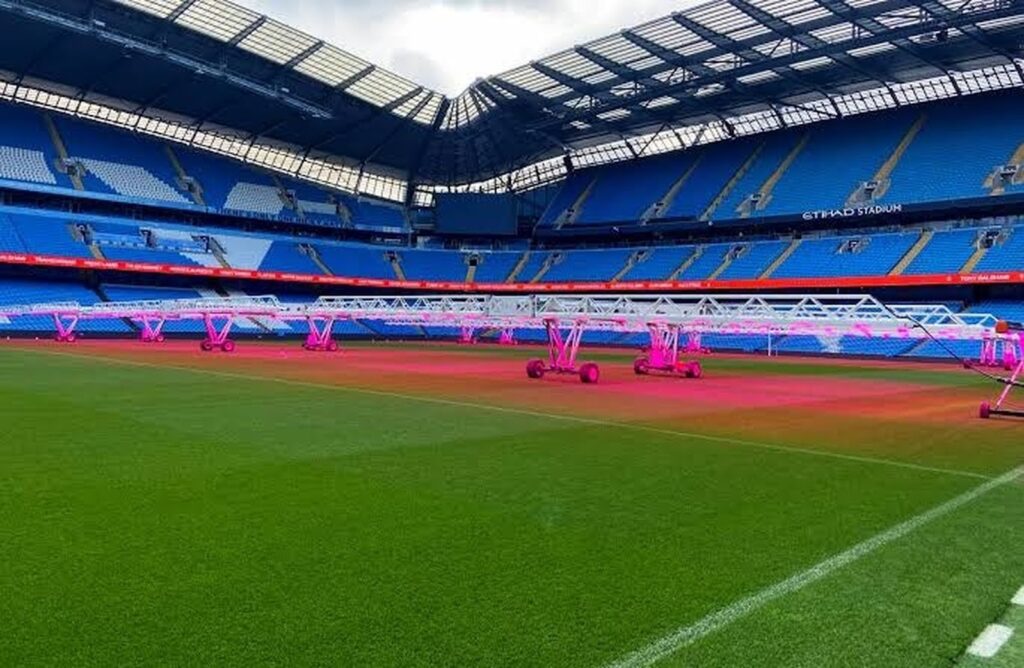
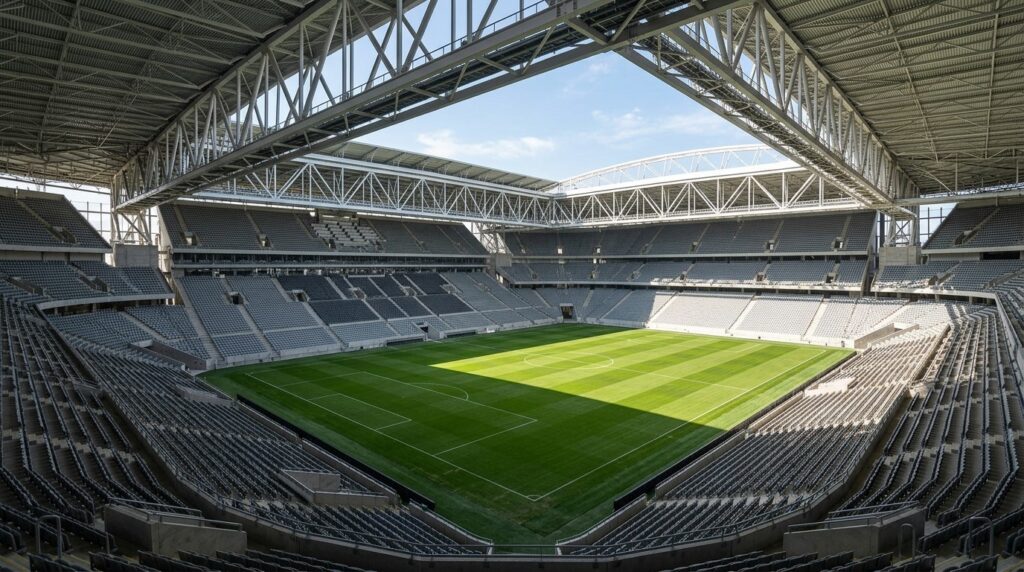
Walk into almost any modern soccer stadium and you will notice the same architectural trend: taller stands, deeper roof structures, and less open sky above the playing surface.
That design creates a better environment for spectators, but it can create a serious agronomic challenge for the turf.
The grass still needs light.
When stadium structures significantly reduce natural sunlight, turfgrass may receive less of the light required for photosynthesis, growth, density, and recovery from heavy traffic. This is why supplemental lighting has become an increasingly important tool in professional stadium turf management.
Artificial lighting does not replace good agronomy. Instead, it helps compensate for one of the most difficult limitations of modern stadium environments: insufficient natural light at the turf canopy.
This article explains why professional soccer stadiums use supplemental lighting, how LED and high-pressure sodium (HPS) systems work, how turf managers can evaluate the actual light deficit, and how lighting decisions should be integrated with turfgrass selection, irrigation, fertility, and field maintenance.
Why Modern Stadiums Can’t Rely on Sunlight Alone
Grass needs light to photosynthesize. Read too: What Is a High-Performance Soccer Field? The Complete Technical Guide
Plants use a portion of the electromagnetic spectrum known as photosynthetically active radiation (PAR), generally defined as wavelengths from approximately 400 to 700 nanometers.
However, simply knowing the wavelength range is not enough to evaluate whether a soccer field receives adequate light.
Professional turf managers also need to consider how much light reaches the canopy and how much accumulates over an entire day.
Two measurements are particularly important:
- PPFD — Photosynthetic Photon Flux Density: the instantaneous amount of photosynthetically active photons reaching a unit of surface area, expressed as μmol m⁻² s⁻¹.
- DLI — Daily Light Integral: the total amount of photosynthetically active radiation received over a 24-hour period, expressed as mol m⁻² d⁻¹.
In other words, PPFD tells you how much usable light is reaching the turf at a given moment, while DLI tells you how much usable light the turf receives over the entire day.
This distinction matters in stadiums because sunlight changes constantly with the season, time of day, cloud cover, roof geometry, stand height, and sun angle.
Peer-reviewed research on sports turf has demonstrated that low light can reduce turfgrass quality and wear tolerance, while supplemental lighting can improve turf quality, density, and wear tolerance under shaded conditions.
Light Deficit Is a Stadium-Specific Problem
There is no universal number of supplemental lighting hours that works for every stadium.
The required lighting period depends on:
- natural sunlight reaching the field;
- stadium orientation and architecture;
- season and latitude;
- turfgrass species and cultivar;
- expected traffic;
- maintenance schedule;
- environmental conditions;
- desired recovery rate.
UEFA’s stadium guidance specifically notes that the required lighting period depends on natural light transmission to the playing surface, playing schedules, maintenance, and environmental conditions.
This means the first question should not be:
“How many hours should we run the grow lights?”
A better question is:
“How much light is the turf receiving naturally, and how much additional light does the field need?”
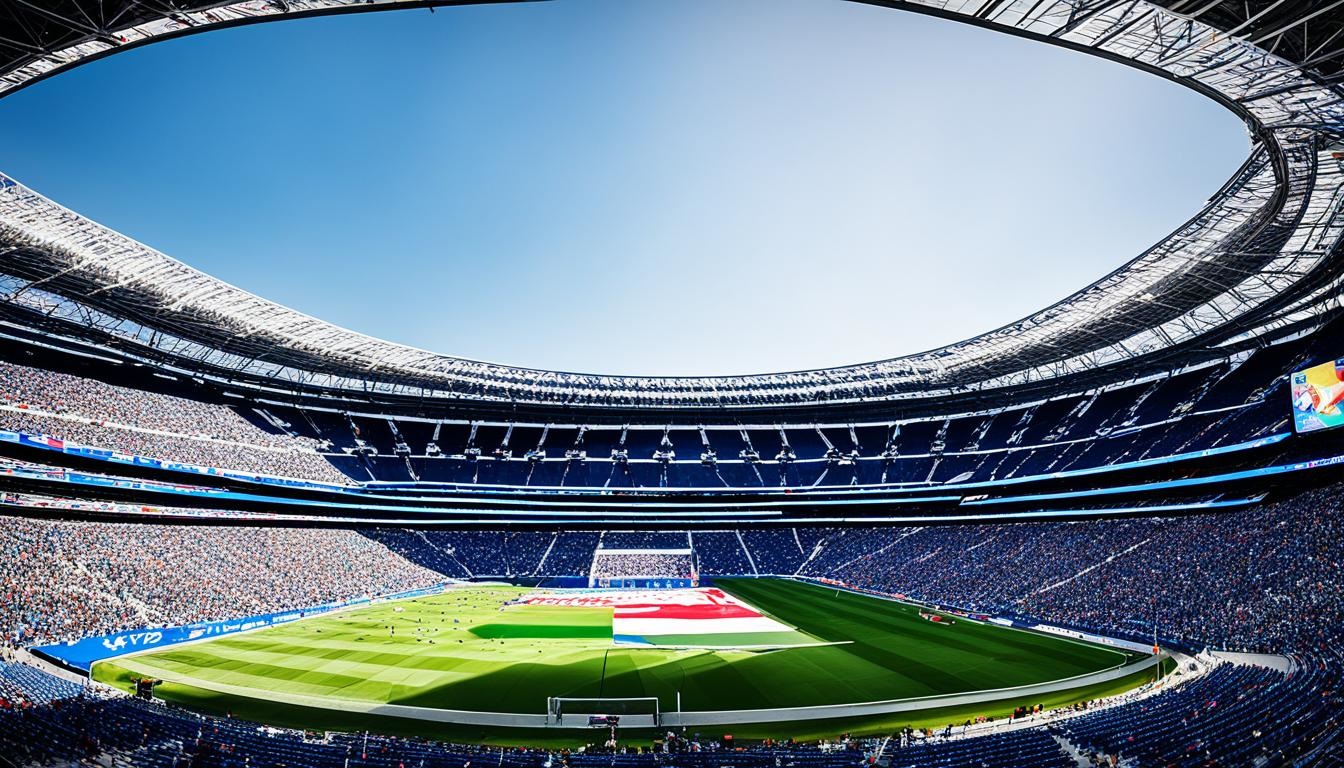
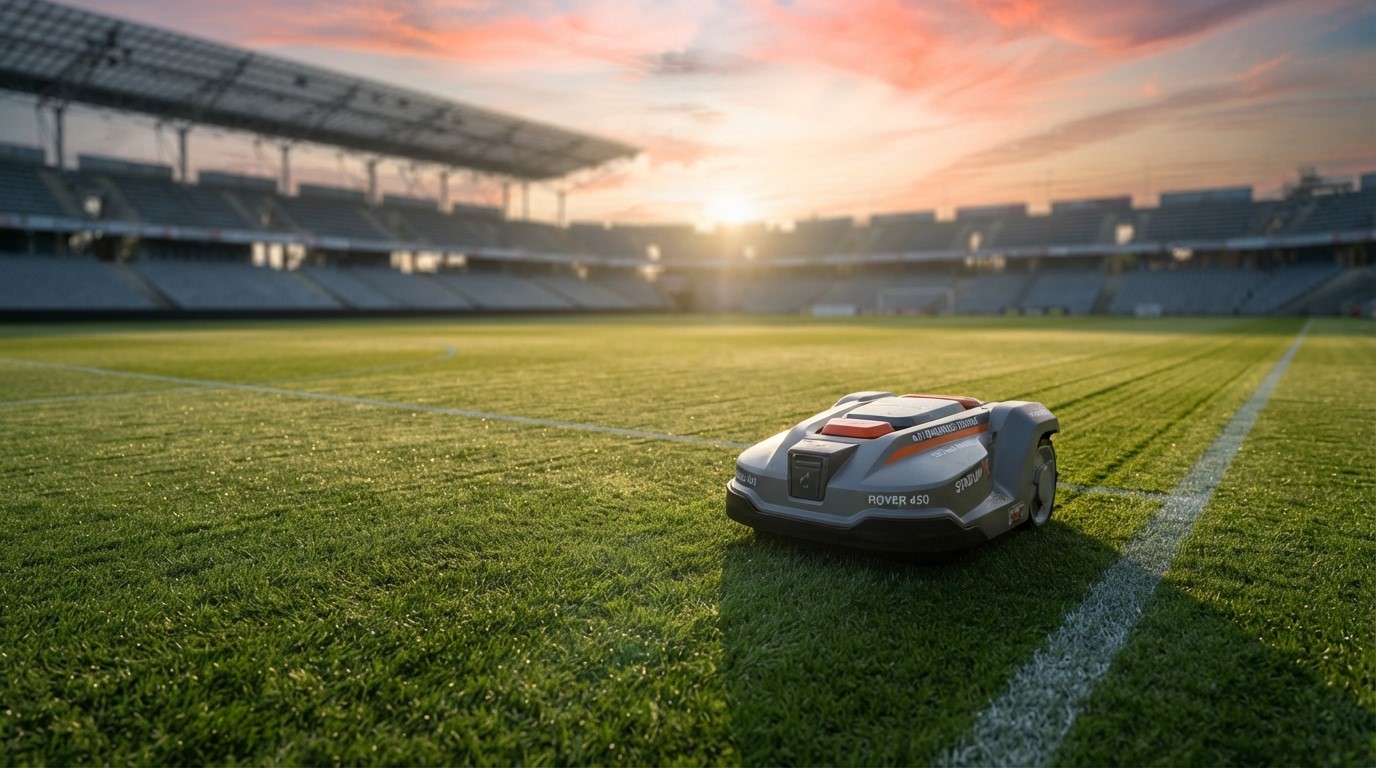
Image Suggestion: Wide interior view of a modern professional soccer stadium showing deep roof structures and tall stands casting extensive shadows across the natural grass playing surface.
Alt Text: Interior view of a modern soccer stadium with roof structures and tall stands casting shadows across the natural grass playing surface.
How Grow Lighting Technology Actually Works
Supplemental lighting systems provide additional photosynthetically active radiation to turfgrass when natural sunlight is insufficient.
The objective is not simply to make the field brighter. The objective is to provide enough usable light to support photosynthesis, growth, density, and recovery under the stadium’s specific environmental conditions.
Professional systems generally use mobile lighting rigs that can be positioned over shaded areas of the field. Some facilities move the rigs regularly to distribute light across different sections of the playing surface, while others concentrate lighting on chronically shaded or heavily worn areas.
UEFA guidance states that artificial lighting rigs can provide sufficient photosynthetically active radiation to support active growth and recovery of both cool- and warm-season turfgrass in stadium environments. It also notes that lighting duration should be adjusted according to natural light transmission and field conditions.
PPFD and DLI: Two Numbers Turf Managers Should Understand
A lighting system should be evaluated by the amount of light it actually delivers to the turf—not simply by the number of fixtures or their electrical wattage.
PPFD measures instantaneous light intensity at the canopy.
DLI measures the accumulated light received over a full day.
For example, a peer-reviewed sports-turf study conducted under winter conditions measured an average DLI of approximately:
| Lighting condition | Average DLI |
|---|---|
| Shade | 7.1 mol m⁻² d⁻¹ |
| Shade + HPS | 12.3 mol m⁻² d⁻¹ |
| Shade + LED | 12.0 mol m⁻² d⁻¹ |
The study found that supplemental lighting substantially increased the daily light received by the turf and improved turf quality, density, and wear tolerance in several cool-season species.
Importantly, those DLI values should not be interpreted as universal requirements for every soccer field.
The same study estimated minimum DLI levels associated with acceptable scores for different turfgrass species under its experimental conditions, including approximately 8.4 mol m⁻² d⁻¹ for perennial ryegrass, 8.9 for Kentucky bluegrass, and 9.3 for tall fescue. These values came from a specific experiment and should be used as research context—not universal stadium thresholds.
That distinction is critical.
The correct lighting target depends on the species, cultivar, environment, turf condition, and performance objective.
HPS vs. LED Supplemental Lighting
High-pressure sodium systems have historically been widely used in professional stadiums because they provide both photosynthetically useful light and substantial heat.
LED systems have become increasingly common because they generally require less energy and offer greater control over light output.
| Factor | HPS | LED |
|---|---|---|
| Light efficiency | Lower | Higher |
| Energy consumption | Generally higher | Generally lower |
| Heat output | High | Lower |
| Spectral control | More limited | Greater flexibility |
| Dimming/control | More limited | Highly controllable |
| Additional heating | Naturally generated | May require dedicated infrared |
| Typical advantage | Light + heat in cold environments | Energy efficiency and controllability |
| Best fit | Facilities where thermal input is valuable | Facilities prioritizing efficiency and flexible light management |
Peer-reviewed research comparing HPS and LED supplemental lighting found that both technologies improved turf quality, density, and wear tolerance under shade, with no significant difference between HPS and LED for the turf traits evaluated in that study. LED nevertheless required less energy.
FIFA’s stadium guidance similarly notes that LED systems have become increasingly common because of their lower lifecycle and energy costs. It also notes that some newer LED rigs incorporate infrared heating when additional heat is required.
Therefore, LED should not simply be described as “better.”
It is generally more energy-efficient and controllable, while HPS can provide useful thermal input in cold environments.
The best technology depends on the stadium’s actual light and environmental requirements.
Key Recommendations for Turf Managers Evaluating Grow Lighting
1. Start With a Light Transmission Analysis
Before purchasing supplemental lighting, determine where and when the field receives insufficient natural light.
A professional assessment should consider:
- seasonal sun angles;
- roof and stand geometry;
- shaded areas;
- natural PPFD;
- daily light accumulation;
- turfgrass species;
- match and training schedules;
- expected recovery requirements.
The objective is to identify the actual light deficit rather than estimating requirements from visible shade alone.
A field can look bright from the stands and still receive substantially less usable light at the turf canopy than an open-air field.
2. Measure PPFD and Consider DLI
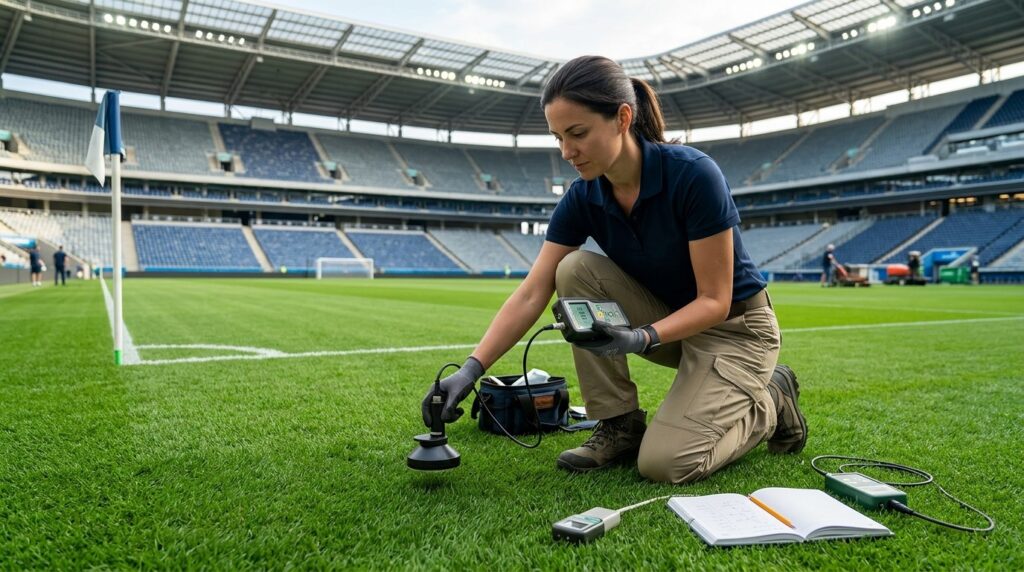
If possible, measure or model the amount of light reaching the turf canopy.
PPFD measurements can identify areas that consistently receive less light, while DLI provides a broader picture of the total daily light available to the turf.
This creates a much more useful management question:
Is supplemental lighting actually closing the field’s daily light deficit?
Simply running lights for a predetermined number of hours does not answer that question.
3. Match the Technology to the Stadium Environment
Cold-climate venues may benefit from the additional heat produced by HPS systems.
Facilities where heat is not required may gain greater efficiency from LED technology.
FIFA notes that some LED systems can incorporate infrared heating when thermal input is needed, although adding heat increases energy consumption.
The decision should therefore consider:
- light output;
- energy consumption;
- heat requirements;
- operating hours;
- electrical infrastructure;
- maintenance;
- equipment mobility;
- capital cost;
- expected service life.
4. Prioritize Shade-Tolerant Turfgrass Selection
Supplemental lighting should not be used to compensate indefinitely for poor turfgrass selection.
Different species and cultivars respond differently to low-light conditions.
The peer-reviewed sports-turf study discussed earlier found substantial differences among cool-season species under shade, demonstrating that turfgrass selection remains an important component of the overall strategy.
For warm-season turf, cultivar selection is equally important.
A shade-tolerant turfgrass can reduce the size of the supplemental-lighting requirement, while an inherently shade-sensitive cultivar may require more artificial light to maintain acceptable density and recovery.
The best strategy is usually:
appropriate turfgrass selection + adequate natural light + supplemental lighting + good agronomy.
5. Adjust Irrigation and Fertility Based on Plant Response
Supplemental lighting can increase turfgrass activity and recovery, but the presence of grow lights does not automatically mean irrigation should increase.
Actual water demand depends on:
- evapotranspiration;
- air temperature;
- humidity;
- vapor pressure deficit;
- canopy temperature;
- rootzone moisture;
- turfgrass species;
- rooting depth;
- growth rate;
- natural daylight;
- lighting intensity and duration.
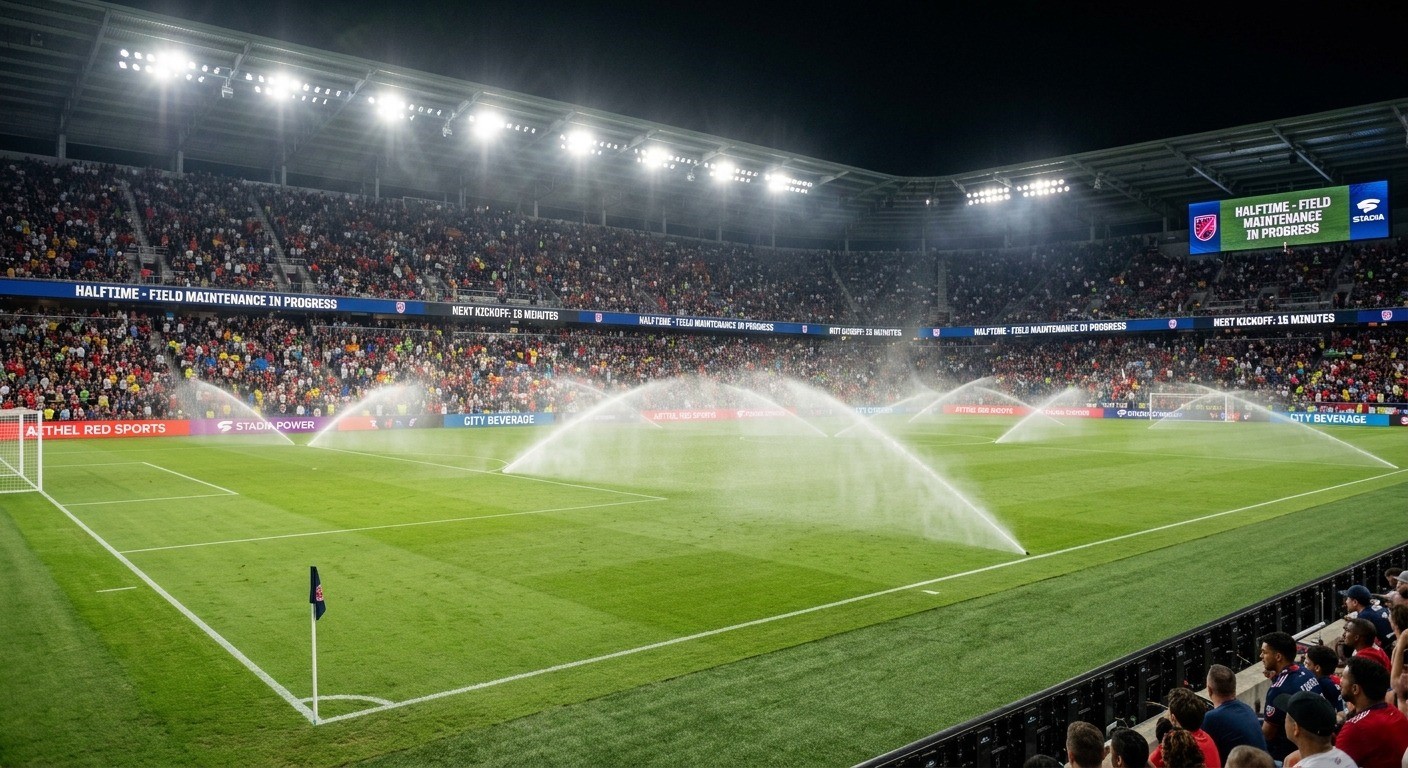
If supplemental lighting increases active growth, irrigation and fertility programs may need adjustment. Read to: 10 Sports Turf Irrigation Mistakes That Waste Thousands of Gallons Every Year
However, those adjustments should be based on measured plant and rootzone conditions, not simply on the number of hours the lights operate.
For irrigation, combine weather and ET information with rootzone moisture monitoring and field observations.
For fertility, use turf growth, tissue testing, soil/rootzone testing, and the facility’s fertility program to determine actual nutrient requirements.
This is especially important because excessive irrigation can reduce root-zone oxygen, increase disease pressure, and create soft playing conditions. TurfWaterPro’s guide on overwatered sports turf provides a practical framework for diagnosing these problems.
6. Budget for Coverage, Infrastructure, and Logistics
Don’t evaluate a lighting project based only on the price of the lighting rigs.
The total project may also require:
- electrical capacity;
- power distribution;
- storage space;
- equipment movement;
- maintenance access;
- control systems;
- rig transportation;
- field protection;
- supplemental heating where required.
UEFA reports that the largest artificial-lighting rigs currently on the market have lighting footprints of approximately 360–440 m². Configurations of three, six, or nine large rigs are commonly used for full-pitch coverage, with additional smaller rigs used in high-wear areas.
That should be viewed as an industry example—not a universal design specification.
The correct number of rigs depends on the stadium’s light deficit, fixture output, operating strategy, field geometry, and recovery requirements.
Common Mistakes to Avoid
Treating Grow Lights as a Substitute for Good Agronomy
Supplemental lighting compensates for a light deficit.
It does not replace:
- correct mowing;
- aeration;
- appropriate fertility;
- irrigation management;
- drainage;
- turfgrass selection;
- disease management;
- traffic management.
A field with inadequate agronomy will not become a high-performance field simply because grow lights are installed.
Ignoring Shade-Tolerant Cultivar Selection
Choosing a turfgrass with poor adaptation to the stadium’s light environment and attempting to compensate entirely with artificial lighting can increase energy use and operating costs.
The better strategy is to select turfgrass according to the site’s climate, light environment, traffic, recovery requirements, and management capacity.
Underestimating Electrical Infrastructure
Large supplemental-lighting systems can place substantial demands on a stadium’s electrical infrastructure.
Electrical capacity should therefore be evaluated before the lighting system is selected.
Retrofitting power distribution after installation can increase project cost, complicate stadium operations, and create unnecessary downtime.
Running Lights on a Fixed Schedule
One of the most common mistakes is treating supplemental lighting like a simple timer.
Natural light changes throughout the year.
So do:
- turf growth;
- weather;
- stadium shade;
- match schedules;
- training schedules;
- field wear;
- recovery requirements.
A more advanced lighting program uses actual light and environmental data to determine when and where supplemental lighting provides the greatest benefit.
The goal is not maximum lighting.
The goal is efficient lighting that closes the turf’s light deficit without unnecessary energy consumption.
Ignoring Equipment Logistics
Mobile lighting rigs must be moved, stored, powered, and positioned.
Every movement across the field introduces operational considerations and potentially additional traffic.
A lighting plan should therefore include:
- equipment storage;
- access routes;
- movement procedures;
- electrical connections;
- staff requirements;
- field protection;
- maintenance schedules.
Supplemental lighting is both an agronomic system and an operational system.
Conclusion
Artificial lighting in professional soccer stadiums is not simply a technology trend.
It is a practical response to a fundamental agronomic problem: modern stadium architecture can significantly reduce the amount of natural light reaching the turf.
The most effective lighting programs begin by measuring the problem.
Turf managers should evaluate natural light transmission, PPFD, DLI, turfgrass response, environmental conditions, field usage, and recovery requirements before deciding how much supplemental lighting is necessary.
LED technology offers important advantages in energy efficiency and control, while HPS can still provide valuable thermal input in cold environments. Neither technology, however, should be considered a substitute for appropriate turfgrass selection and disciplined agronomic management.
The same principle applies to irrigation.
Grow lights may change the plant’s growth environment, but irrigation should still respond to ET, rootzone moisture, weather, turfgrass demand, and field observations rather than to a fixed lighting schedule.
For professional stadiums, the real objective is not simply to install grow lights.
It is to create a controlled light environment that allows the turf to recover, maintain density, and perform consistently under heavy traffic.
The key question for a turf manager is therefore not:
“Which grow lights should we buy?”
It is:
“How much light is the turf receiving, how much is it missing, and what is the most efficient way to close that deficit?”
That shift—from buying equipment to managing the turf’s actual light environment—is what turns supplemental lighting from an expensive technology into a strategic sports turf management tool.
FAQ
Why do professional soccer stadiums use artificial lighting on the field?
Modern stadium structures can significantly reduce natural sunlight reaching the turf. Supplemental lighting provides additional photosynthetically active radiation to support photosynthesis, growth, density, and recovery in areas affected by low light.
What is PPFD in sports turf lighting?
PPFD, or Photosynthetic Photon Flux Density, measures the amount of photosynthetically active light reaching a specific area of turf at a given moment. It is expressed in μmol m⁻² s⁻¹.
What is DLI and why does it matter?
DLI, or Daily Light Integral, represents the total amount of photosynthetically active radiation received by the turf over a 24-hour period. It is expressed in mol m⁻² d⁻¹.
DLI is useful because turfgrass responds not only to light intensity at a specific moment but also to the total amount of usable light accumulated during the day.
How much DLI does soccer field turf need?
There is no single DLI requirement for every soccer field.
Turfgrass species, cultivar, climate, season, temperature, wear, and other environmental factors all influence the amount of light required.
One peer-reviewed sports-turf study found estimated minimum DLI values under its experimental conditions of approximately 8.4 mol m⁻² d⁻¹ for perennial ryegrass, 8.9 for Kentucky bluegrass, and 9.3 for tall fescue to achieve acceptable performance scores. These values should not be treated as universal thresholds for professional stadiums.
Is LED or HPS better for stadium grow lighting?
Neither is universally better.
LED systems generally offer lower energy consumption and greater control, while HPS systems produce more heat, which can be useful in cold environments.
Research has shown that both HPS and LED supplemental lighting can improve turf quality, density, and wear tolerance under shade.
How many grow lights does a professional soccer stadium need?
There is no universal number.
UEFA reports that large rigs can cover approximately 360–440 m², with configurations of three, six, or nine large rigs commonly used for full-pitch coverage, plus smaller rigs for high-wear areas. Actual system requirements depend on the stadium’s light deficit, field geometry, fixture output, and management strategy.
Does supplemental lighting increase irrigation requirements?
It can, but not automatically.
If additional lighting increases turf growth and transpiration, water demand may increase. However, irrigation should be adjusted according to ET, weather, rootzone moisture, turfgrass response, and actual field conditions—not simply according to lighting hours.
Can artificial lighting replace shade-tolerant turfgrass?
No.
Supplemental lighting works best as part of an integrated management strategy. Selecting turfgrass appropriate for the stadium’s light environment can reduce the amount of supplemental lighting required and improve long-term turf resilience.
Do grow lights generate heat?
HPS systems generate considerably more heat than conventional LED systems.
This can be beneficial in cold environments. Some modern LED systems can also incorporate infrared heating when additional thermal input is required, although this increases energy consumption.
Managing turf in a modern stadium is no longer just about choosing the right grass.
Light, water, rootzone conditions, irrigation uniformity, weather, traffic, and recovery all interact to determine how the field performs.
If you’re responsible for a professional soccer field, athletic complex, or high-performance sports turf system, explore the TurfWaterPro resource library for practical guidance on irrigation scheduling, soil moisture monitoring, irrigation audits, turfgrass selection, water management, and field performance.
Want to take your field management from visual assessment to data-driven decision-making?
Explore more TurfWaterPro guides and learn how better irrigation, monitoring, and turf management can help build a more consistent and resilient playing surface.
References
FIFA — Turf and Pitch Design / Grow Lights
FIFA’s stadium guidance discusses artificial lighting as a tool for compensating for stadium shadow, compares HPS and LED, and notes the possibility of infrared heating with some LED systems.
UEFA — Artificial Lighting Systems
UEFA’s stadium guidance addresses supplemental lighting, the 400–700 nm PAR range, lighting duration, and typical rig footprints and configurations.
Abélard, E. & Galbrun, C. (2022). The effects of artificial lighting on sports turf. International Turfgrass Society Research Journal.
Peer-reviewed research evaluating HPS and LED supplemental lighting effects on turf quality, density, wear tolerance, PPFD, and DLI.
FIFA — Stadium Guidelines: Technical Systems and Services
Provides broader guidance on LED stadium lighting, efficiency, control, glare, energy consumption, and system design.



One Response
Excellent technical article.