

This article is Part 2 of our series: Bare Spots on Soccer Fields: A Complete Guide to Diagnosis, Repair and Prevention.
In Part 1, we explored the main causes of bare spots on soccer fields, including player traffic, soil conditions, irrigation problems, and environmental stress. To better understand the factors behind these problems, read our previous article about the Causes of bare spots on soccer fields.
Now, in Part 2, we focus on how to identify the underlying causes before starting any repair work.
A proper diagnosis is essential for selecting the right recovery strategy, avoiding unnecessary maintenance costs, and preventing the same problems from returning.
Before repairing bare spots, understand why they developed.
How to Diagnose Bare Spots Before Repairing Them
The first step in a successful repair is identifying the underlying cause.
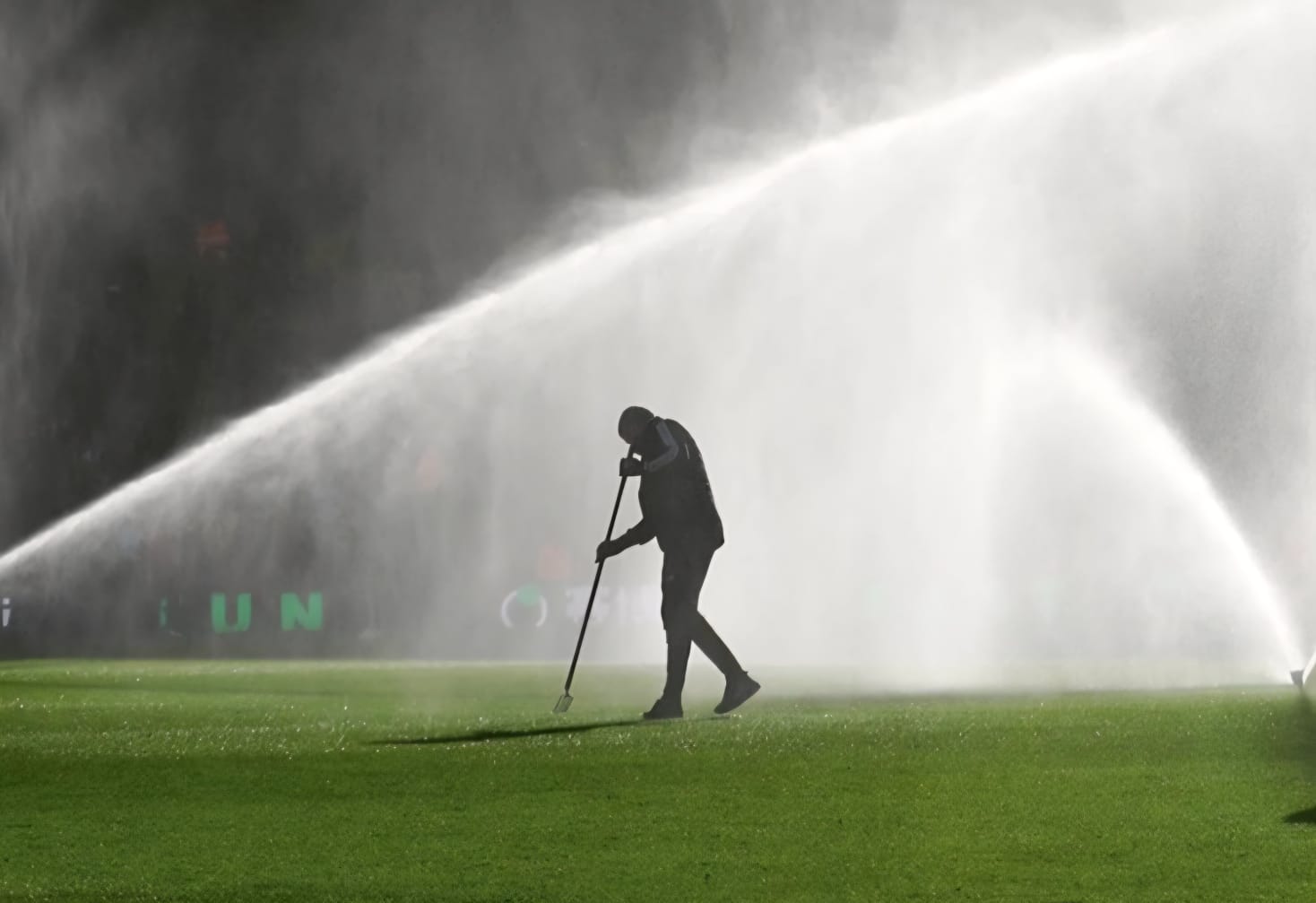
A field inspection should consider the location, shape, severity, and pattern of turf loss. These observations often provide useful clues about what is happening below the surface.
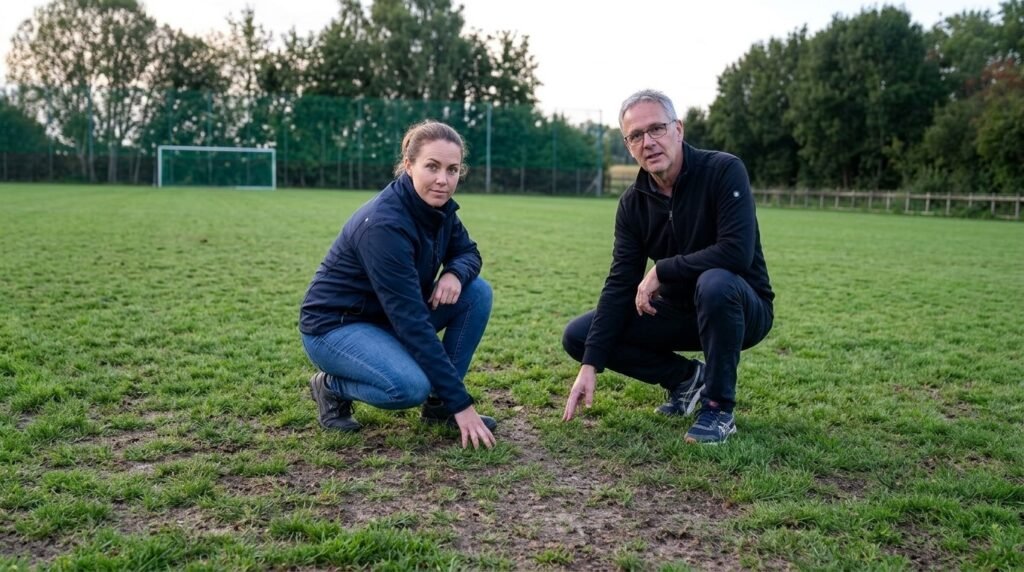
Fig 1. Sports Turf Manager Inspecting Bare Spots on a Soccer Field.
Start With a Field Inspection
Map the affected areas and look for recurring patterns.
For example:
- Bare areas in front of the goals may indicate concentrated player traffic.
- Irregular dry patches may suggest uneven irrigation or differences in soil water availability.
- Persistent wet areas may indicate drainage limitations, low spots, or excessive irrigation.
- Thin turf beneath trees or near stadium structures may be associated with insufficient sunlight.
- Circular or irregular patches that do not correspond to traffic patterns may require investigation for pests or disease.
Do not assume that every bare area has the same cause. A soccer field may contain several different problems that require different repair strategies.
Integrating these observations into a structured soccer field maintenance plan can help identify recurring problems and establish maintenance priorities.
Evaluate Soil Conditions
Soil testing helps identify pH and nutrient limitations that may interfere with turfgrass growth.
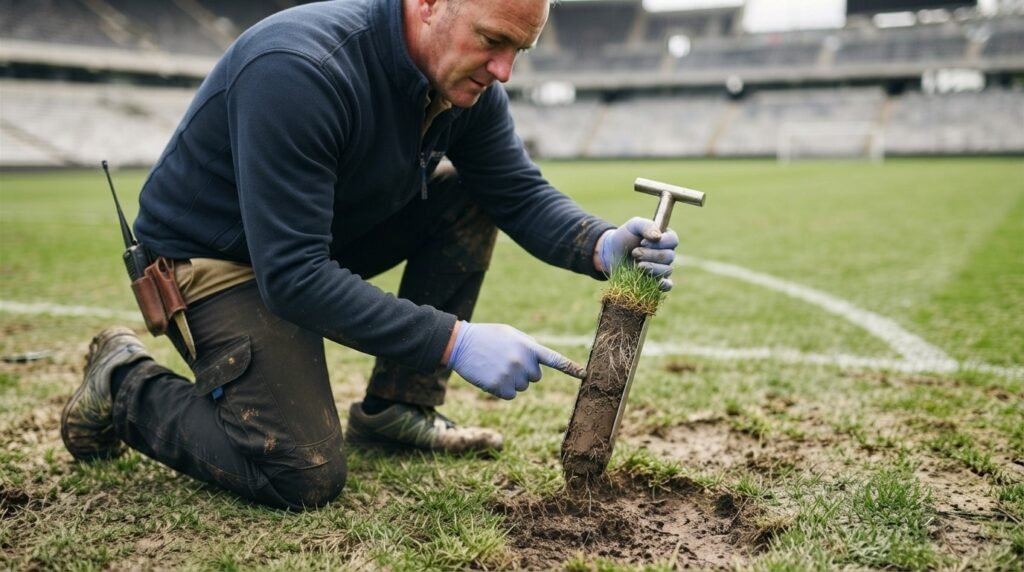
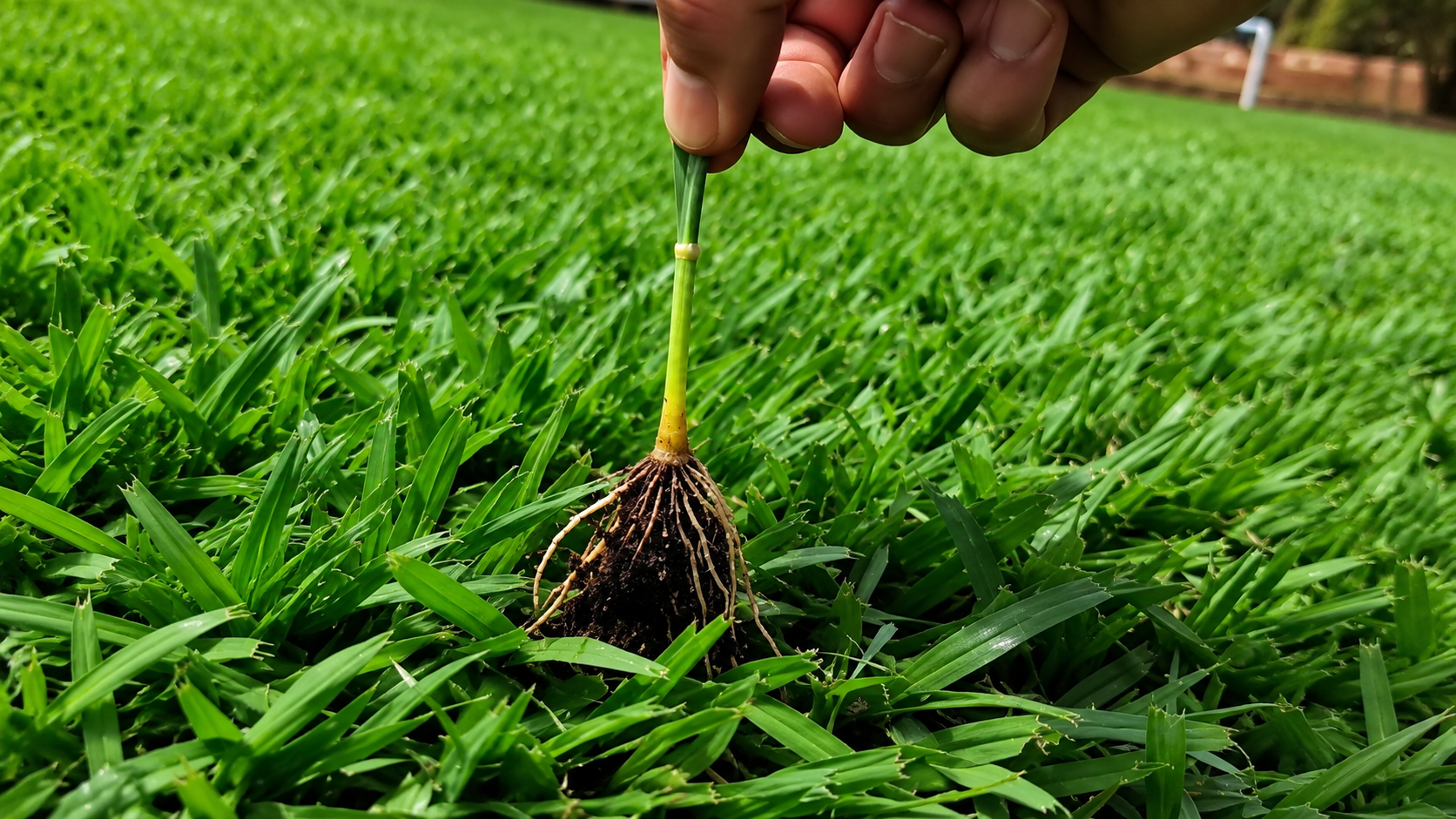
Fig 2. Soil Core Sampling for Soccer Field Turfgrass Diagnosis.
Penn State Extension recommends collecting approximately 20 to 32 soil cores from a representative area, combining them into a composite sample, and submitting the sample to a laboratory.
For field diagnosis, also examine:
- Rooting depth and root distribution.
- Soil compaction.
- Surface firmness.
- Infiltration behavior.
- Soil texture and moisture conditions.
- Evidence of standing water or runoff.
A soil probe is a practical tool for comparing moisture conditions and rooting depth across different parts of the field.
Audit Irrigation System Performance
Irrigation should be evaluated before increasing water application.
Begin with a visual inspection of every relevant irrigation zone. Look for broken or tilted sprinkler heads, clogged nozzles, leaks, incorrect alignment, and signs of pressure problems. For a more comprehensive approach, follow our soccer field irrigation maintenance checklist to evaluate sprinkler performance, operating pressure, and system uniformity.
Next, conduct a catch-can test to measure how uniformly the system applies water.
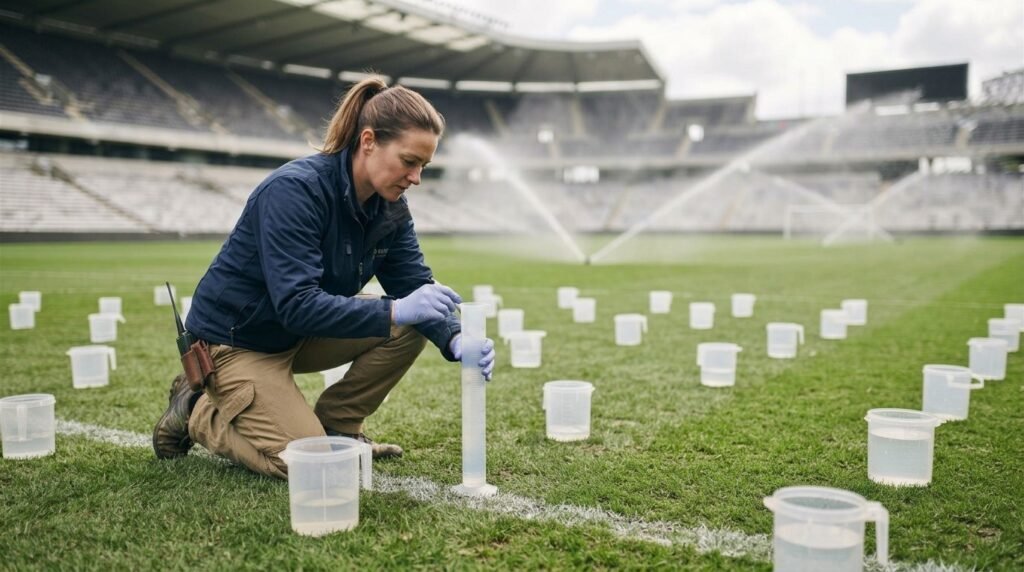
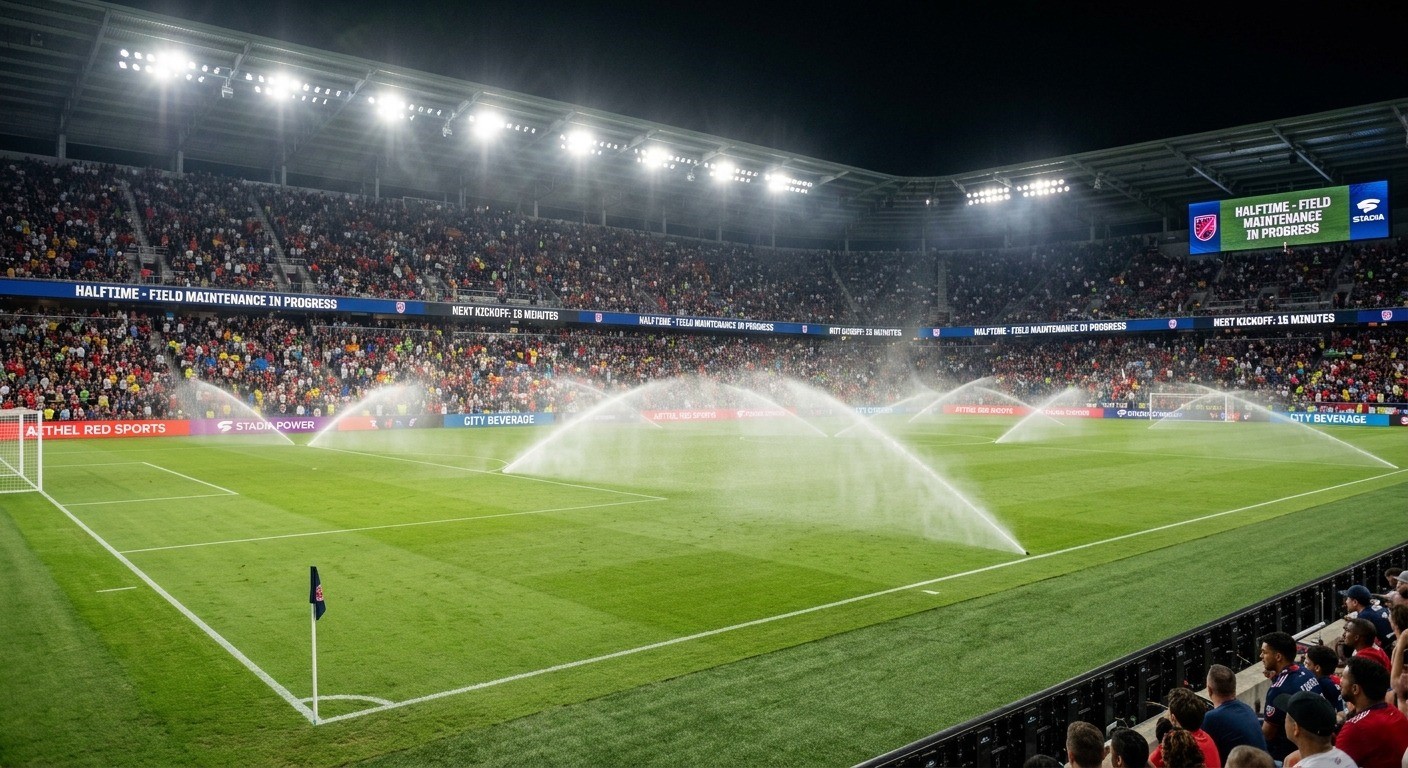
Fig. 3 Catch-Can Irrigation Audit on a Professional Soccer Field.
For a professional irrigation audit use at least 24 uniform catch cans per irrigation zone. The test should be performed under normal operating conditions, particularly with respect to system pressure and wind.
The measurements can be used to calculate:
Average precipitation rate
This indicates how quickly the system applies water, usually expressed in inches per hour.
Low-quarter distribution uniformity (DUₗq)
This compares the average water collected in the driest 25% of catch cans with the average collected across all cans.
A low DUₗq indicates that some parts of the irrigation zone receive substantially less water than others. To better understand how irrigation uniformity affects turfgrass health and water management, read our guide on distribution uniformity (DU) in turfgrass irrigation.
The results help identify whether dry areas may be associated with poor sprinkler coverage or system performance.
However, a catch-can test measures water distribution at the surface. It does not directly measure rootzone moisture, infiltration, or drainage.
For that reason, combine the audit with soil moisture observations and field inspection.
Check Soil Moisture at Representative Locations
Compare soil moisture in healthy and damaged areas.
Measurements should represent the active rootzone and consider the differences in soil texture, rooting depth, and field construction.
If soil moisture sensors are available, use them to monitor selected locations over time. Handheld probes can also provide useful comparisons when used consistently.
Remember that a single measurement represents only a specific location and depth. It should not be interpreted as the moisture condition of the entire field.
The objective is to determine whether the damaged area is consistently too dry, excessively wet, or experiencing moisture conditions similar to nearby healthy turf.
Stay Connected with TurfWaterPro
Looking to improve your sports turf management knowledge?
Follow TurfWaterPro for research-based articles, practical irrigation strategies, turfgrass science, and professional insights to help you maintain healthier, more resilient, and better-performing soccer fields.
Explore. Learn. Improve Your Field.
Coming Next: Part 3 – How to Repair Bare Spots on Soccer Fields
Identifying the cause of bare spots is only the first step. The next challenge is restoring turfgrass coverage and improving the field’s ability to withstand future wear.
In Part 3 of our complete guide, we’ll explore practical methods for repairing bare spots on soccer fields, including soil preparation, seeding, sod installation, topdressing, and irrigation management during turfgrass establishment.
Stay tuned to TurfWaterPro and follow our series to learn how to diagnose, repair, and prevent bare spots on professional soccer fields.